Now Reading: PHP vs Python: Web Scripting Languages Compared
-
01
PHP vs Python: Web Scripting Languages Compared

Language Basics: PHP vs Python
Both PHP and Python are widely used for server-side scripting, but they emerged from different design goals and ecosystems. PHP started as a tool to embed simple scripts into HTML and has evolved into a robust language powering large web apps. Python began as a general-purpose language focused on readability and productivity, and it gained traction in web development through frameworks that emphasize clean design and modularity. Understanding these roots helps explain common trade-offs: PHP often offers straightforward deployment on traditional LAMP stacks and tight integration with CMSs, while Python emphasizes expressive syntax, a rich standard library, and flexible deployment options across WSGI servers, containers, and cloud services.
In practice, the choice between PHP and Python often aligns with project context and team strengths. PHP tends to excel in environments with existing CMS-driven workflows or where rapid templating and content management features are a priority. Python, by contrast, shines in broader application domains—data processing, API-centric services, automation, and scenarios requiring a wider ecosystem of libraries beyond the web layer. The decision frequently comes down to whether the project prioritizes CMS compatibility and rapid front-end delivery or modular, scalable architecture with a broader ecosystem of tooling.
- Syntax style and readability: PHP’s C-like syntax with embedded scripting versus Python’s indentation-based blocks.
- Typing: both are dynamically typed, with optional typing in Python via type hints and PHP’s gradual typing in newer versions.
- Ecosystem focus: PHP has deep web-automation through CMSs and frameworks; Python provides general-purpose tools and scientific computing libraries.
- Deployment patterns: PHP typically runs in-process with the web server; Python often runs under WSGI/ASGI with a separate application server.
- Community and support: decades of web-specific resources for PHP; broad, cross-domain resources for Python.
Syntax and Code Style
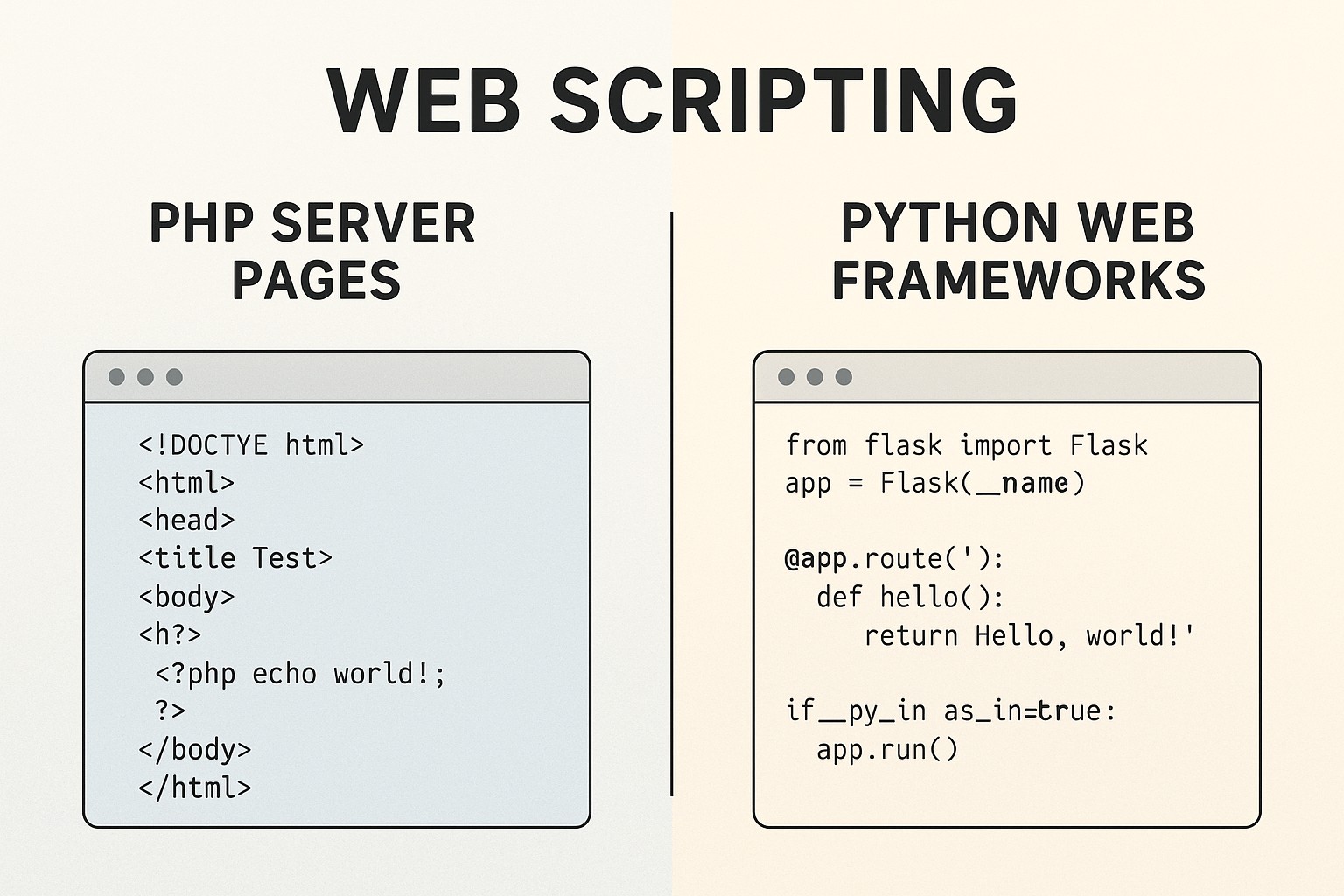
The syntax of PHP and Python reflects their messaging: PHP mixes with HTML is common in templates, while Python emphasizes readability and consistent coding style across projects. In PHP, you can echo HTML directly, or you can separate logic from presentation using templates. Python tends to separate concerns via frameworks and templates as well, but the language itself leans toward clear, explicit constructs. As a result, teams often adopt coding standards aimed at maintainability, such as consistently using functions, modules, and clear error handling patterns that transcend language particulars.
Code examples below illustrate typical patterns. They show how you would fetch a request parameter, perform a small operation, and return a response in each language. The PHP example demonstrates a straightforward in-script calculation and output, while the Python example mirrors a minimal route handler suitable for a lightweight framework or microservice. In real-world projects, you would expand these snippets with validation, error handling, and proper input sanitization.
// PHP example
// Python example (Flask-like)
from flask import Flask, request
app = Flask(__name__)

@app.route('/sum')
def sum_route():
    a = int(request.args.get('a', 0))
    b = int(request.args.get('b', 0))
    return f"Sum: {a + b}"
In practice, prefer clear naming, consistent formatting, and explicit error handling to reduce maintenance costs, regardless of language choice.
Web Frameworks: Laravel vs Django
Frameworks define how you structure applications, manage data, and build maintainable features. Laravel, the PHP framework, emphasizes elegant syntax, expressive routing, and a mature ecosystem of packages. Django, the Python framework, emphasizes batteries-included design, strong security defaults, and a clear project layout. Each framework shapes project architecture and developer velocity differently. Laravel often appeals to teams seeking rapid front-end integration with robust tooling and a large library of ready-made components. Django tends to attract teams that value a well-defined project skeleton, built-in admin interfaces, and a comprehensive set of conventions that reduce decision fatigue during development.
When choosing between them, consider team experience, existing codebases, and the desired delivery cadence. Laravel tends to be a natural fit for teams that want rapid UI and admin interfaces connected to an SQL database. Django suits teams seeking a comprehensive, opinionated stack with strong admin interfaces and robust security features out of the box. Both frameworks promote testability and maintainability, but the emphasis on ecosystem conventions can influence long-term scalability and onboarding.
- Routing and URL design: Laravel’s route definitions vs Django’s URL dispatcher.
- Object-relational mapping: Eloquent in Laravel vs Django ORM, with migration tooling.
- Authentication and security: built-in features that reduce boilerplate but require conventions.
Performance and Security Considerations
Performance and security influence long-term maintainability and operational cost. PHP performance has improved with modern runtimes and opcache, and many CMSs continue to run efficiently at scale with proper caching and CDN strategies. Python performance typically relies on a capable web server and careful concurrency planning, including async frameworks for high I/O workloads. Security practice follows language and framework defaults: validate input, sanitize output, and keep dependencies updated. Both ecosystems reward disciplined deployment patterns, including code review, dependency pinning, and automated security checks.
In practice, you should profile endpoints, apply caching strategically, and isolate services. Consider static code analysis, dependency management, and vulnerability scanning as standard parts of your deployment cycle. Organizations that adopt a layered security model—from input validation to output escaping and secure session handling—tend to experience fewer issues as applications grow in traffic and complexity.
| Aspect | PHP | Python |
|---|---|---|
| Concurrency model | Typically multi-process or multi-threaded with frameworks like Laravel/Lumen | Async support in frameworks like FastAPI, Django channels |
| Deployment | PHP in-process with web server (Apache, Nginx + PHP-FPM) | WSGI/ASGI with app servers (gunicorn, uvicorn) |
| Community resources | Huge ecosystem around CMSs (WordPress, Drupal) | Broad scientific and web ecosystem across domains |
Use Cases and Ecosystem
PHP remains deeply entrenched in content management systems and many e-commerce platforms. Python powers a broad range of applications, from rapid APIs to data-driven services, and is favored when the project benefits from a wide set of libraries and tooling. The ecosystem shapes what you can achieve quickly and how easily you can hire developers with relevant experience. In practice, organizations often choose PHP for sites that require rapid CMS-based development and straightforward hosting, while Python is selected for projects that demand diverse programming tasks beyond the web layer, such as data processing, automation, and API-centric services.
Consider where your project will live: CMS-driven sites might benefit from PHP-based stacks, while data pipelines or API-first services may be more productive in Python. Both languages integrate well with modern deployment pipelines, containers, and cloud services. The right ecosystem choice can shorten time-to-value and reduce the learning curve for new team members, especially when the project anticipates growth in features and integrations over time.
- Content management and websites: WordPress, Drupal, Joomla (PHP) vs API-first services and microservices (Python).
- E-commerce platforms: Magento/Shopify integrations (PHP) vs custom Python-based stores or headless setups.
- Automation and tooling: scripting, data processing, and automation tasks across both languages.
Choosing Between PHP and Python
Make your decision based on project goals, team skills, and long-term maintenance. If your primary goal is delivering a PHP-based site or leveraging an existing CMS with a rich ecosystem of plugins, PHP remains a practical and dependable choice. If you require a broader programming language for diverse workloads, data processing, or rapid API development, Python offers a flexible and scalable path. The decision is rarely binary: many teams maintain a core PHP front end while leveraging Python services for data-intensive tasks or specialized functionality.
Practical guidelines include evaluating existing code assets, computing resources, and vendor support. A practical mix is also common: core systems in PHP for web front-ends, with Python services handling data-intensive tasks in separate microservices. Regardless of language choice, establish consistent development standards, reliable CI/CD processes, and robust monitoring to maximize uptime and maintainability as requirements evolve.
FAQ
Is PHP still relevant for modern web development?
Yes. PHP powers a large portion of the web today, with modern versions providing performance improvements, robust tooling, and a vibrant ecosystem around content management and e-commerce platforms.
Which language is easier for beginners to learn for web development?
Python tends to be easier to learn due to its readable syntax and consistent style, while PHP has a gentler entry point for those building web pages with embedded scripts.
Which is better for large-scale web applications, PHP or Python?
Both can scale, but Python often provides more options for service-oriented architectures, data processing, and asynchronous I/O; PHP scales well when using modern frameworks and proper caching and deployment strategies.
Can I mix PHP and Python in the same project?
Yes, many architectures employ services written in different languages, communicating via APIs, queues, or shared databases. This approach can leverage the strengths of each language where appropriate.
What deployment considerations matter most when choosing?
Consider hosting environment compatibility, the available tooling for your chosen language, and the ease of scaling with your expected traffic. PHP often benefits from in-process deployment and robust CMS ecosystems, while Python benefits from containerized, microservice-oriented deployments.