Now Reading: Self-Service Analytics: What It Is and How to Implement It
-
01
Self-Service Analytics: What It Is and How to Implement It

What is self-service analytics?
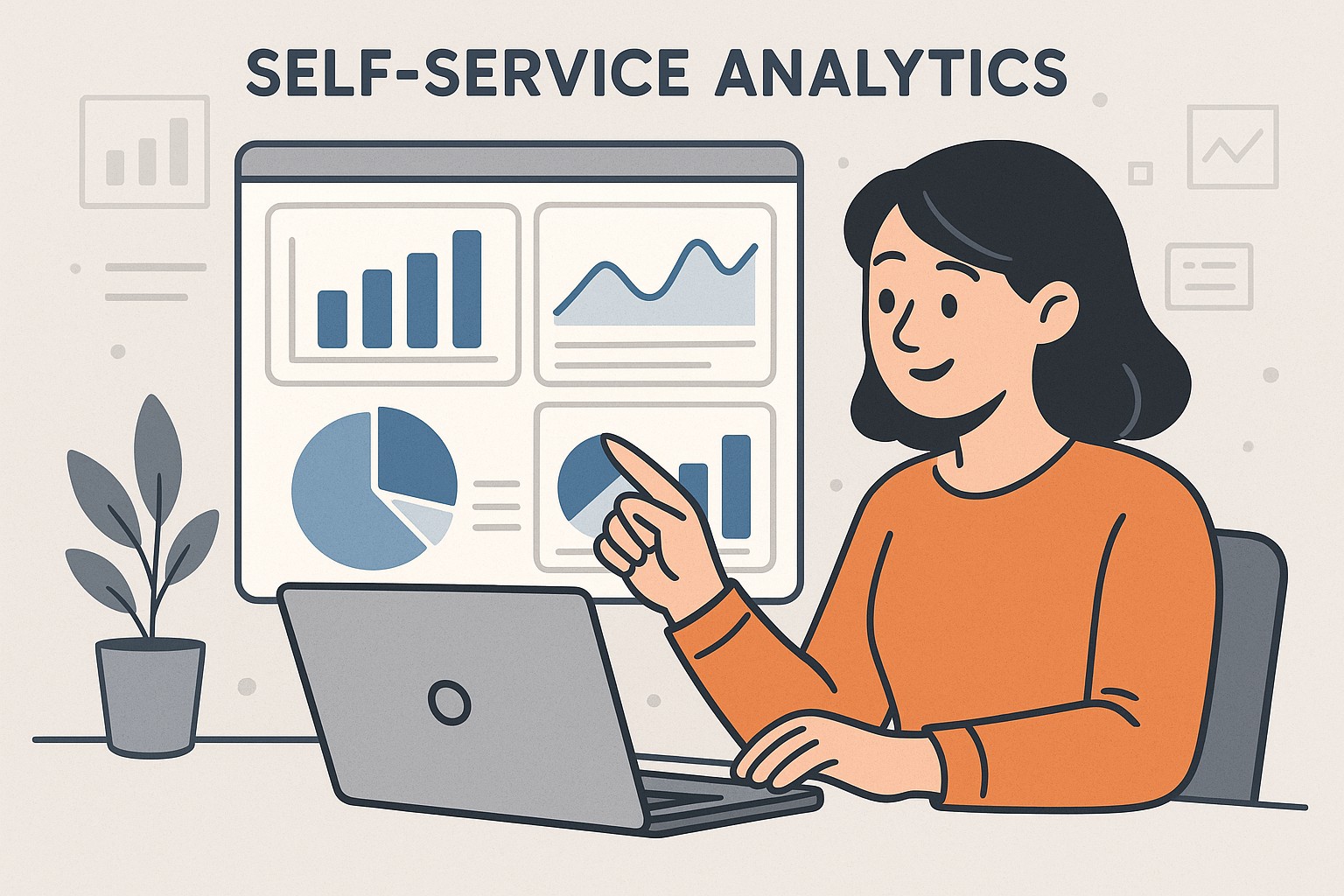
Self-service analytics describes an operating model in which business users can access data, prepare it, and generate insights without needing to wait for central IT to run queries or deliver reports. The aim is to shorten the cycle from question to answer while preserving data integrity, security, and governance. In practice, it blends data discovery, data preparation, ad-hoc analysis, and dashboarding into a workflow that non-technical users can navigate with reasonable independence, yet within guardrails defined by the organization. This balance—speed with control—helps organizations move faster in a data-driven economy while maintaining trust in the underlying data assets.
At its core, self-service analytics is not about eliminating governance; it is about enabling responsible exploration with well-defined standards, metadata, and quality checks. Characteristics include intuitive interfaces that abstract complex data processes, guided analytics that steer users toward reliable patterns, and a data catalog that documents definitions, lineage, and usage rules. When implemented thoughtfully, self-service analytics reduces the cognitive load on analysts and empowers business teams to test hypotheses, explore scenarios, and validate decisions against consistent, auditable data sources.
- Self-service data access and discovery
- Self-service data preparation and blending
- Ad-hoc reporting and dashboarding
- Collaboration and knowledge sharing across teams
Benefits and business impact
When deployed with a sustainable governance framework and a focus on data literacy, self-service analytics delivers meaningful and measurable benefits. Analysts and business users gain the confidence to pose new questions, test hypotheses, and iterate quickly, reducing the time from inquiry to action. This acceleration supports faster product improvements, more effective marketing optimization, and sharper customer insights, enabling organizations to respond to market signals with greater agility.
Beyond speed, the approach improves operational efficiency and alignment. Teams experience fewer handoffs to IT, a clearer understanding of data lineage and definitions, and greater consistency in the metrics that matter. As datasets are standardized and cataloged, collaboration improves because users operate from a shared, understood data foundation rather than duplicating work across silos. This clarity supports better governance outcomes and a stronger correlation between analytics activities and business results.
- Faster time-to-insight and decision support
- Reduced bottlenecks in IT and data teams
- Improved data quality through shared standards
- Enhanced collaboration and data literacy across the organization
- Greater consistency in metrics and definitions
- Better alignment between analytics and strategic objectives
Governance, data quality, and risk management
Effective self-service analytics rests on a lightweight but robust governance model that specifies data ownership, access controls, data lineage, and quality checks. The objective is to protect sensitive information and regulatory requirements while enabling responsible exploration. A pragmatic governance design emphasizes automation, metadata management, and continuous monitoring to keep controls aligned with evolving business needs. By codifying policy into repeatable patterns, organizations can scale self-service without sacrificing trust in data assets.
Key components include a data catalog describing datasets, definitions, and lineage; automated data quality rules that validate accuracy and completeness; and role-based access controls that enforce privacy safeguards. With these guardrails, users gain confidence in the data, and IT maintains visibility into how data is used, by whom, and for what purpose. The governance approach should be documented, iterated, and communicated widely so that new users understand the expectations and the logic behind restrictions and incentives.
- Define governance roles and responsibilities, including data stewards and product owners
- Standardize terminology, metrics, and data definitions across domains
- Implement automated data quality checks and lineage tracking
- Establish access controls and privacy safeguards aligned with regulations
- Monitor usage, audit changes, and continuously improve processes
To complement this, organizations should publish a concise governance playbook that describes how datasets are created, validated, and deployed for self-service use. Regular reviews and feedback loops help sustain trust in the data and keep the program aligned with changing business needs and regulatory landscapes.
Tooling, architecture, and data preparation
Choosing the right tooling is essential for delivering a scalable, maintainable self-service analytics platform. The typical technology stack combines a data catalog, a self-service analytics/BI layer, data preparation capabilities, and a governance layer that enforces policy. The design should support a catalog-driven discovery experience, metadata-backed lineage, and repeatable data preparation patterns that are accessible to non-technical users while codifying best practices for data engineers. A well-integrated stack reduces time-to-value and minimizes rework caused by silos between data producers and data consumers.
In practice, many organizations converge on a layered architecture: a data ingestion/storage layer, a semantic or curated layer exposing business concepts, and a self-service interface that surfaces datasets, explorations, and dashboards. The interplay of these layers, supported by strong data literacy programs and clear ownership, helps prevent duplicate datasets and divergent metrics. To illustrate how these pieces come together, the following at-a-glance representation highlights common capabilities and contrasts between approaches:
Tooling snapshot (at a glance)
Self-service BI tool | Traditional BI platform
Ease of use for analysts | Requires specialized IT support
Data preparation capabilities | Limited or outsourced to ETL team
Data catalog integration | Strong emphasis on metadata
Automation of governance | Largely manual processes
Implementation roadmap and best practices for success
A practical rollout typically follows a phased approach starting with a controlled pilot and expanding to broader user cohorts. Early focus areas include data domains with clear business value, a defined set of self-service use cases, and a governance baseline that can scale. The plan should incorporate measurable milestones, risk assessments, and a feedback loop that captures user satisfaction, data quality, and governance effectiveness. A deliberate, iterative rollout reduces risk while building organizational trust in the platform.
As adoption grows, invest in data literacy and role-based training, plus comprehensive documentation that clarifies data definitions, lineage, and recommended workflows. It is equally important to establish a support model that blends automated guidance with human assistance to help users resolve issues without compromising governance. Finally, maintain an ongoing evaluation of tool capabilities, data sources, and integration patterns to ensure the platform remains resilient as the business environment evolves.
Sample rollout outline
Phase 1: Define scope, data sources, and success metrics
Phase 2: Deploy catalog, governance policies, and self-service interfaces
Phase 3: Scale to additional domains, enforce quality checks, and monitor usage
Phase 4: Optimize through training, metadata, and continuous improvement
FAQ: What is self-service analytics?
Self-service analytics is a governance-enabled approach that enables business users to access, prepare, and analyze data with minimal reliance on centralized IT, while maintaining data quality, lineage, and security through automated policies and metadata-driven practices.
FAQ: How do you ensure governance while enabling self-service BI?
Governance is built into the platform through a catalog of trusted datasets, clear ownership, automated data quality checks, role-based access controls, and documented lineage. By combining policy with automation and user education, you can preserve control without creating bottlenecks for everyday analysis.
FAQ: What metrics should you track to measure success?
Key metrics include time-to-insight, user adoption rates, data quality scores, the number of self-service datasets in use, dashboard accuracy and consistency, and the alignment of analytics outcomes with business KPIs such as revenue growth, cost optimization, or customer satisfaction.
FAQ: What are common challenges and how can you mitigate them?
Common challenges include data silos, inconsistent definitions, data quality issues, and resistance to change. Mitigations involve establishing a shared data glossary, implementing automated quality checks, promoting data literacy, and running governance as a collaborative, ongoing program rather than a one-off project.
FAQ: How should an organization start with self-service analytics?
Begin with a focused pilot that targets a high-value domain, establish a minimal but effective governance baseline, create a starter data catalog, and provide hands-on training to early adopters. Use the pilot to refine success metrics and governance controls before scaling to additional teams and datasets.