Now Reading: Server-Side vs Client-Side Rendering: Web Performance Impacts
-
01
Server-Side vs Client-Side Rendering: Web Performance Impacts

Introduction
In modern web development, rendering strategy has a profound impact on perceived performance, search visibility, and the rhythm of user interactions. Server-Side Rendering (SSR) and Client-Side Rendering (CSR) are the two dominant paradigms that guide how content is produced and presented to users. This article explains how SSR and CSR differ in practice, what each approach means for page load times, SEO outcomes, and the overall user experience, and how to choose between them in real-world business applications.
As organizations increasingly rely on front-end ecosystems built around frameworks like React, Vue, and Angular, the rendering choice also interacts with tooling, hosting, and styling libraries. For teams considering Angular Material versus Bootstrap, the rendering path interacts with how component libraries ship CSS and how hydration costs are managed. The discussion here focuses on performance budgets, reliability, and maintainability, offering pragmatic guidance for product managers, engineers, and IT leadership.
Server-Side Rendering (SSR) fundamentals
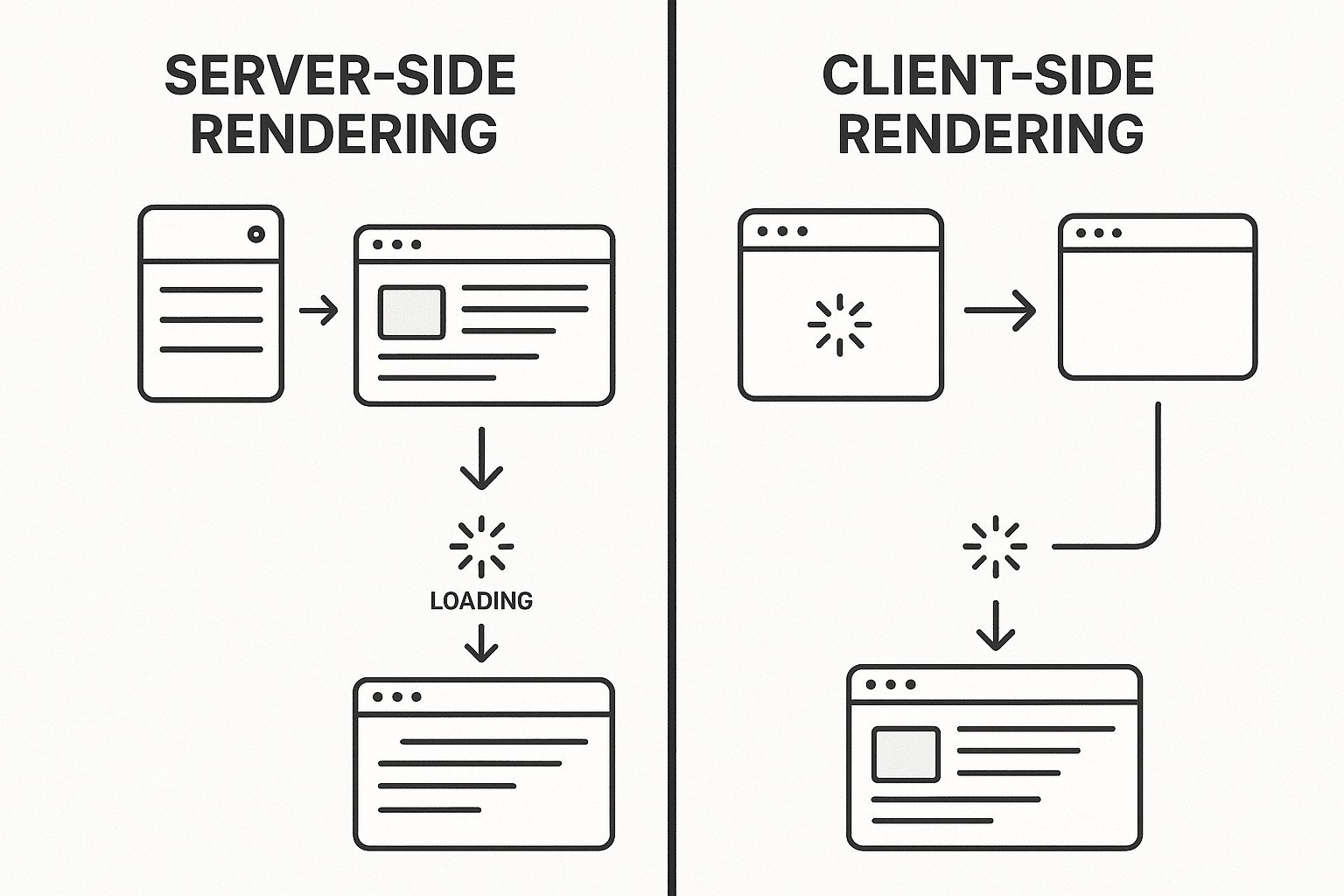
Server-Side Rendering describes a workflow in which the server composes the full HTML for a page on each request and sends a ready document to the browser. The user can begin viewing content almost immediately, while the browser hydrates interactivity with client-side JavaScript. This model tends to improve the initial paint and crawlability, making it attractive for content-driven sites and pages that benefit from strong SEO signals.
In practice, SSR workflows involve rendering templates on the server, fetching data, and streaming or delivering complete markup to the client. Developers must consider server capacity, caching layers, data-fetching strategies, and how to manage per-request state. Below is a minimal, language-agnostic example illustrating the core idea of rendering a page on the server and sending HTML to the client. This example is not tied to a specific framework, but it captures the essential steps you would implement in your stack.
// Pseudo SSR example
function renderPage(data) {
  const html = `${data.title}
    ${data.content}`;
  return html;
}
From an architectural perspective, SSR often benefits from careful caching, streaming rendering where supported, and efficient data loading strategies to avoid bottlenecks on the server. It can also influence how styling is delivered, since CSS and critical assets may need to be available early in the response. For teams working with Angular Material or Bootstrap, SSR interactions with styling layers and component initialization can affect hydration costs and the perceived speed of the first meaningful render.
Client-Side Rendering (CSR) fundamentals
Client-Side Rendering shifts the rendering workload from the server to the browser. After an initial HTML shell is delivered, JavaScript bundles load, fetch data from APIs, and render the UI on the client. CSR can reduce server load and enable highly interactive experiences, making it a natural fit for applications with complex client-side state and dynamic UI updates.
Framework ecosystems such as React, Vue, and Angular offer robust CSR capabilities, including state management, routing, and component libraries. However, CSR places extra emphasis on bundling strategies, code-splitting, and hydration approaches if a hybrid path is used. Styling libraries—whether CSS-in-JS, CSS Modules, or utility-first CSS—also influence how quickly the UI paints and becomes usable on the client. The following points highlight key CSR characteristics to inform planning and risk assessment.
- Fast subsequent navigations and rich interactivity once the JS bundle is loaded
- Potentially slower initial load time on slower networks or devices
- Better offline and dynamic client-side behavior due to heavy use of JavaScript
- SEO and social previews can be challenged unless mitigated with pre-rendering or server-assisted strategies
Performance and SEO implications
Performance is multi-dimensional, and the choice between SSR and CSR influences several core metrics. SSR typically yields a lower Time to First Byte (TTFB) and faster First Contentful Paint (FCP) because the server delivers ready HTML. Hydration work on the client then adds cost to become fully interactive, which can affect Time to Interactive (TTI). CSR, by contrast, often shows faster interactivity after the initial bundle loads, but the initial paint may be delayed if the JavaScript payload is large or if data fetching occurs after the HTML is rendered.
SEO considerations are closely tied to how content is delivered and indexed. SSR generally offers stronger guarantees for search engines by delivering meaningful HTML on the initial load, improving crawlability and indexability. CSR relies on the browser to render content, and while modern search engines can execute JavaScript, indexing behavior remains variable across engines and devices. A balanced approach—accompanied by pre-rendering of critical pages or a streaming SSR strategy—often provides reliable SEO while preserving interactive capabilities. The table below contrasts SSR and CSR across key performance and SEO dimensions.
| Metric | SSR | CSR |
|---|---|---|
| Time to First Byte (TTFB) | Lower when server renders quickly and uses caching | Unaffected by server-side rendering; depends on API latency |
| First Contentful Paint (FCP) | Often rapid due to pre-rendered HTML | Dependent on when JS and data arrive; may be slower at start |
| Largest Contentful Paint (LCP) | Improved with above-the-fold HTML | Improved with code-splitting and prioritizing critical assets |
| Time to Interactive (TTI) | Hydration adds overhead, can lengthen TTI | Often sooner after bundles load, if hydration is optimized |
| SEO/Content Indexing | Predictable HTML supports robust indexing | Depends on bot capabilities; SSR or prerendering improves reliability |
Architectural considerations and decision guide
Choosing SSR or CSR is rarely a pure binary decision. Most teams benefit from a pragmatic mix: use SSR or prerendering for content-first pages and leverage CSR for highly interactive sections where user input and dynamic updates dominate. Infrastructure choices—such as serverless functions, edge rendering, and caching layers—also shape cost, latency, and reliability. The right architecture often blends streaming SSR, selective hydration, and robust caching to achieve a balanced performance profile.
To operationalize the decision, start with a baseline assessment of core pages, categorize routes by data dynamics and SEO needs, and establish measurable targets for each category. A practical guideline is to SSR for content-heavy pages and resort to CSR for interactive experiences, while exploring hybrid or hybrid-with-edge strategies for mixed pages. Ensure the plan aligns with team capabilities, deployment processes, and monitoring to support ongoing optimization.
- Content-first pages: SSR or prerendering to enhance SEO and initial paint
- Dynamic dashboards and apps: CSR with API-driven data and targeted hydration
- Edge rendering and caching: push SSR-like responses closer to users to reduce latency
- Hydration strategy: define when and how to hydrate client components to minimize TTI
Operational considerations and implementation patterns
Beyond the architectural trade-offs, teams must address practicalities such as deployment pipelines, caching strategies, and monitoring. A robust plan includes clear separation of responsibilities between server render paths and client hydration logic, as well as a strategy for rolling out changes safely and measuring impact. This section outlines concrete patterns to support reliable, scalable rendering architectures.
- Deployment: maintain separate build and deployment pipelines for SSR and CSR assets with explicit versioning
- Caching: implement edge caching and appropriate cache invalidation to keep content fresh
- Monitoring: instrument end-to-end performance from the user’s device back to the server, with alerting on regressions
- Skills and governance: ensure teams have coverage for both server-side rendering and client-side optimizations
FAQ
What is server-side rendering (SSR)?
Server-side rendering is the process of generating the full HTML for a page on the server for every request, delivering a ready-to-display document to the browser. This approach improves initial paint and crawlability, but it can increase server workload and requires careful data-fetching and caching strategies to remain scalable.
What is client-side rendering (CSR)?
Client-side rendering moves the rendering work to the browser. The server serves a minimal HTML shell, and JavaScript runs in the client to fetch data and render the UI. CSR supports highly interactive experiences and can reduce server load, but it may delay the initial content delivery and complicate SEO unless mitigated with pre-rendering or hydration strategies.
How do SSR and CSR affect SEO?
SSR generally offers stronger guarantees for search engines by delivering complete HTML on the initial load, improving crawlability and indexing reliability. CSR relies on the browser to render content, and while modern search engines can execute JavaScript, indexing can be variable across engines and devices. A blended approach—serving SSR for key pages and prerendered snapshots for others—often yields robust SEO outcomes.
How should I measure performance differences?
Use a combination of synthetic tests and real user monitoring. Track metrics such as TTFB, FCP, LCP, TTI, and CLS across representative journeys. Compare cold vs warm caches, network conditions, and device classes. Tools like Lighthouse, WebPageTest, and performance monitoring integrated into your analytics stack provide actionable guidance for tuning SSR and CSR strategies.
When should I choose SSR vs CSR?
The choice depends on page type, content dynamics, and business goals. Content-heavy pages with strong SEO requirements often benefit from SSR or prerendering. Highly interactive apps with frequent user input and dynamic data can gain from CSR with optimized hydration and streaming data. Many teams adopt a hybrid approach, applying SSR for critical content and CSR for interactive sections to balance performance, SEO, and maintainability.