Now Reading: Sisense vs Tableau: BI Tools Comparison
-
01
Sisense vs Tableau: BI Tools Comparison

Introduction
Sisense and Tableau are two of the most widely adopted BI platforms in enterprise analytics, but they approach analytics from different angles. Sisense has historically emphasized data engineering, scalable modeling, and embedded analytics that reach beyond traditional BI dashboards. Tableau, by contrast, has built a reputation for flexible visualization, rapid ad hoc exploration, and compelling data storytelling that empowers analysts and business users to discover insights through interaction. In practice, many organizations run both tools side by side, using Tableau for exploration and storytelling in the business unit, while leveraging Sisense for embedded analytics, governed data models, and data-intensive workloads.
This article compares Sisense and Tableau across data integration and modeling, visualization and dashboards, performance and scalability, deployment and governance, and total cost of ownership. The goal is to help decision-makers understand where each platform excels, how they complement or compete with one another, and which scenarios are more favorable to one tool over the other depending on data strategy, governance needs, and end-user requirements.
Core capabilities snapshot
Both platforms offer end-to-end analytics capabilities, including connectors to a wide range of data sources, data preparation, and the ability to publish interactive dashboards for consumption by a broad audience. The practical difference lies in where each platform emphasizes capabilities such as modeling, embedded analytics, and enterprise governance. Tableau remains exceptionally strong in interactive visualization, exploration, and flexible dashboard composition. Sisense emphasizes a scalable data modeling layer that supports embedded analytics at scale and centralized governance for complex data architectures.
In practice, organizations should assess how each platform handles data sources, the complexity of their data models, the degree of self-service desired by business users, and the level of governance required for data quality and security. The best outcomes often come from pairing the strengths of both platforms within a broader analytics strategy or choosing one platform that aligns most closely with the organization’s core analytics workflows and deployment model.
Data modeling & preparation
Data modeling and preparation form the backbone of each platform’s ability to deliver reliable analytics, but the approaches differ. Sisense provides a centralized semantic layer and modeling experience designed to abstract data sources into a unified model, with metrics and transformations defined once and reused across dashboards. This modeling approach is particularly advantageous when you have complex data pipelines or need consistent metric definitions across embedded analytics and multiple consumer cohorts. Tableau, complemented by Tableau Prep, emphasizes connecting to source data, reshaping data, and then exploring it within the visualization layer. The strength of Tableau’s approach is rapid iteration and flexible exploration, which can simplify discovery but may require additional governance steps to ensure metric consistency across reports.
As you plan data modeling, consider how metrics are defined, how joins and unions are managed across diverse sources, and how data lineage is tracked. Sisense’ model tends to reward centralized metric governance and reuse, while Tableau pairs well with source-centric modeling and a culture of self-service exploration tempered by data-quality checks managed through prep flows and governance policies. In environments with heavy embedding or multi-tenant analytics requirements, the modeling discipline becomes even more important to maintain performance and consistency.
Visualization & dashboards
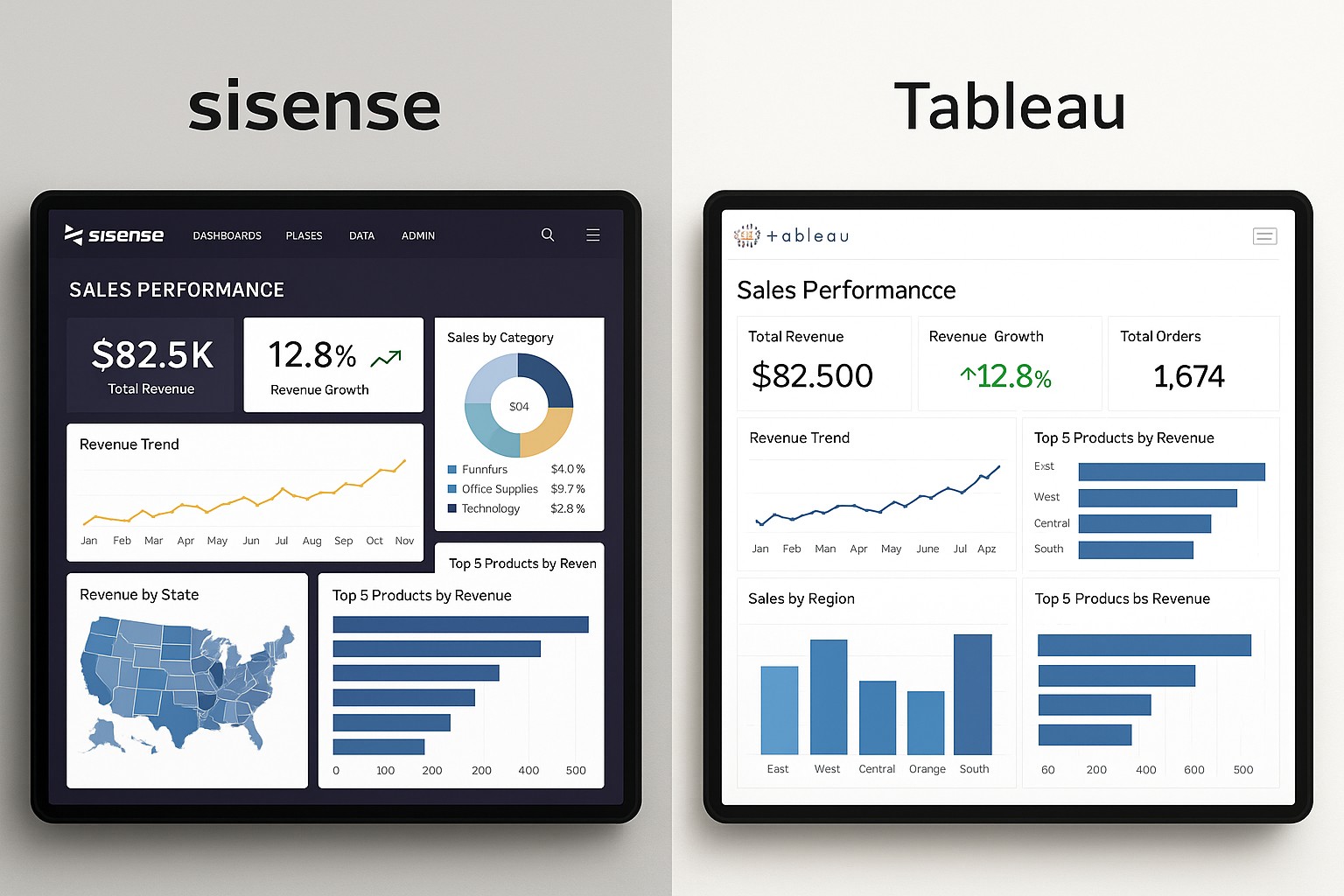
Tableau’s user experience centers on drag-and-drop visualization creation, a broad library of chart types, and interactive capabilities such as filters, parameters, and dashboard actions. Its strength is enabling business users to prototype, compare scenarios, and tell data-driven stories with minimal technical friction. Sisense, while capable of rich visualizations, distinguishes itself through its embedded analytics angle and the ability to deliver dashboards at scale within products or enterprise portals. This is particularly valuable for product analytics teams, sales enablement, or customer-facing analytics where dashboards must live inside applications or websites with consistent governance and performance characteristics.
Dashboard performance is influenced by data model design, query behavior, and the volume of data rendered in the UI. Tableau dashboards typically excel in exploratory analysis and storytelling with responsive interactivity, while Sisense dashboards often emphasize consistent performance in embedded contexts and federated data scenarios where the semantic layer helps optimize repeated workloads. When choosing between them, align visualization capabilities with the end-user workflow: standalone BI analysts and executives may prefer Tableau’s storytelling, whereas product teams and developers embedding analytics may prioritize Sisense’s embedded governance and scalability.
Performance & scalability
Performance considerations vary with data scale, concurrency, and deployment model. Tableau’s performance hinges on the efficiency of the VizQL engine, extract vs live connections, and the capacity of Tableau Server or Tableau Cloud to cache results and parallelize queries. For organizations with large, diverse data sources and high user concurrency, planning for caching strategy, data extracts, and incremental refresh schedules becomes essential to preserve interactive responsiveness. Sisense emphasizes an architecture built around scalable data modeling and in-chip processing or distributed computation, which can yield predictable performance for large data volumes, especially in embedded scenarios where a single semantic layer minimizes ad hoc data duplication.
Operational considerations such as data source optimization, data refresh cadence, and infrastructure sizing are central to both platforms. In cloud deployments, elasticity and auto-scaling options can provide cost-efficient performance, while on-premises ecosystems may require careful capacity planning. For teams evaluating performance, it’s important to define representative user workloads, measure response times for common dashboards, and establish a governance process to maintain performance as data volumes grow or as new data sources are added.
Deployment & governance
Both platforms support flexible deployment options, including cloud-native SaaS offerings and on-premises installations, but their governance footprints reflect different historical emphases. Tableau has long supported centralized governance through Tableau Server or Tableau Cloud, with robust user access controls, project-level permissions, and integration with single sign-on and data security policies. Sisense has focused on governance for embedded analytics and enterprise-scale data models, providing centralized management of data sources, metrics, and access policies that can be leveraged across embedded apps and consumer-facing dashboards.
Security and compliance considerations—such as row-level security, data access policies, audit trails, and integration with identity providers—play a central role in platform selection. Administrators should map data owners, define data lineage, and establish approval workflows for data source connections and metric definitions. In environments where multiple business units publish dashboards or where analytics are embedded in customer-facing applications, the governance model becomes a differentiator: the platform that provides stronger control over data, metrics, and access tends to yield lower risk and faster-scale adoption across lines of business.
Pricing & ROI
Pricing models and the associated total cost of ownership (TCO) influence long-term viability as much as feature depth. Tableau historically offered per-user licenses with distinct Creator, Explorer, and Viewer roles, complemented by subscription tiers tied to server or cloud hosting. Sisense has moved toward capacity-based and per-user licensing in various configurations, with additional considerations for embedded analytics and data modeling workloads. The choice often hinges on whether the organization prioritizes flexible self-service exploration (Tableau) or scalable embedded analytics with centralized governance (Sisense).
ROI considerations should account for licensing terms, hardware and cloud costs, data preparation efforts, and the speed at which insights can be operationalized. In practice, ROI is influenced by how quickly analysts can produce trusted insights, how easily dashboards can be re-used across teams, and how efficiently embedded analytics can be deployed within products or customer portals. When evaluating pricing and ROI, model not only the upfront costs but also ongoing maintenance, upgrade cycles, and the potential for cross-product efficiencies gained from unified data modeling and governance.
Target users & use-case fit
The two platforms tend to align with different user profiles and analytics objectives. Tableau is a natural fit for analysts, data scientists, and business users who prize fast, flexible data exploration and compelling storytelling to influence decisions. Its strength lies in enabling discovery, scenario analysis, and ad hoc reporting with a broad ecosystem of connectors and visualizations. Sisense appeals to teams that require strong data modeling at scale, embedded analytics within products or workflows, and enterprise governance over data assets and metrics. It is well suited for product analytics, multi-tenant dashboards, and environments where a centralized semantic layer accelerates analytics delivery across the organization.
Use-case fit often drives a choice or a hybrid approach. If the primary objective is self-service discovery with curated, governed metrics across a large organization, Tableau paired with a rigorous data governance framework can be highly effective. If the goal is to deliver analytics embedded in applications, provide a centralized data model for consistency, and maintain control over metrics and data access across multiple teams, Sisense offers compelling advantages. In practice, many enterprises adopt a blended approach, selecting Tableau for research and storytelling while leveraging Sisense for embedded analytics and governance-centric dashboards.
Implementation considerations & best practices
To maximize value from either platform, organizations should approach implementation with a structured plan that includes data governance, performance optimization, and a phased rollout. A practical starting point is to align data sources, metrics, and access rights across stakeholders, then pilot with a representative set of dashboards that capture the most critical business questions. Across both platforms, establishing a clear model of metrics (definitions, lineage, and validation rules) helps reduce ambiguity and improves consistency across reports and embedded analytics.
When planning implementation, consider data source heterogeneity, data quality, and the need for real-time versus batch refreshes. Design the data model to minimize duplication, optimize joins or unions, and enable efficient caching and query execution. Establish a governance layer that defines data owners, approval workflows for new metrics, and security policies such as row-level access. Finally, choose a phased rollout that includes training for end users, a feedback loop to refine dashboards, and a measurement plan to track adoption and impact on decision quality.
FAQ
What are the main differences in data modeling approaches between Sisense and Tableau?
Sisense emphasizes a centralized semantic layer and reusable metrics within a data model, which supports consistency across dashboards and embedded analytics. Tableau relies more on source-driven data modeling and prep tools, enabling rapid iteration and exploration, with a focus on flexible visualization rather than centralized metric governance. Organizations often adopt Sisense when governance and embedded analytics across products are essential, and Tableau when exploration, storytelling, and rapid dashboard fabrication are priorities.
Which tool is better for self-service analytics?
Tableau generally excels at self-service analytics due to its intuitive drag-and-drop interface, broad visualization library, and strong ad hoc exploration capabilities. Tableau Prep complements this by enabling analysts to shape data before visualization. Sisense is strong when governance and scalable, embedded analytics are the primary requirements, but for pure self-service exploration by a wide audience, Tableau tends to be the more natural fit.
How do they compare in deployment options and security?
Both platforms support cloud, on-premises, and hybrid deployments, with robust security features and identity integration. Tableau offers mature governance through Tableau Server/Cloud, including granular permissions and SSO integration. Sisense emphasizes governance for large-scale and embedded analytics, focusing on a centralized model for metrics, data sources, and access across embedded apps. The right choice depends on how much emphasis you place on centralized metric governance versus flexible, user-driven exploration with strong embedding capabilities.
What factors should I consider if I’m deciding whether to migrate from one platform to the other?
Key factors include the primary use case (exploration vs embedded analytics), data governance requirements, the complexity of your data model, and the footprint of analytics in products or portals. Migration complexity hinges on data source compatibility, metric definitions, and the need to recreate dashboards and stories in the new environment. A practical approach is to pilot a representative set of critical dashboards, map metrics and data lineage, and establish a governance and migration plan that minimizes disruption to business users.
What is the typical impact on ROI when choosing between these tools?
ROI is driven by speed to insight, adoption rates, governance improvements, and the ability to operationalize analytics. Tableau can deliver rapid value through widespread self-service exploration and storytelling, improving decision-making velocity. Sisense can drive ROI through scalable data modeling, embedded analytics, and governance that reduces data duplication and inconsistencies across dashboards and applications. The best ROI occurs when the chosen platform aligns with the organization’s analytics workflow, embedding strategy, and data governance maturity, while minimizing integration and maintenance costs.