Now Reading: Headless BI: What Is It and Why It Matters
-
01
Headless BI: What Is It and Why It Matters

Understanding Headless BI: Definition and Context
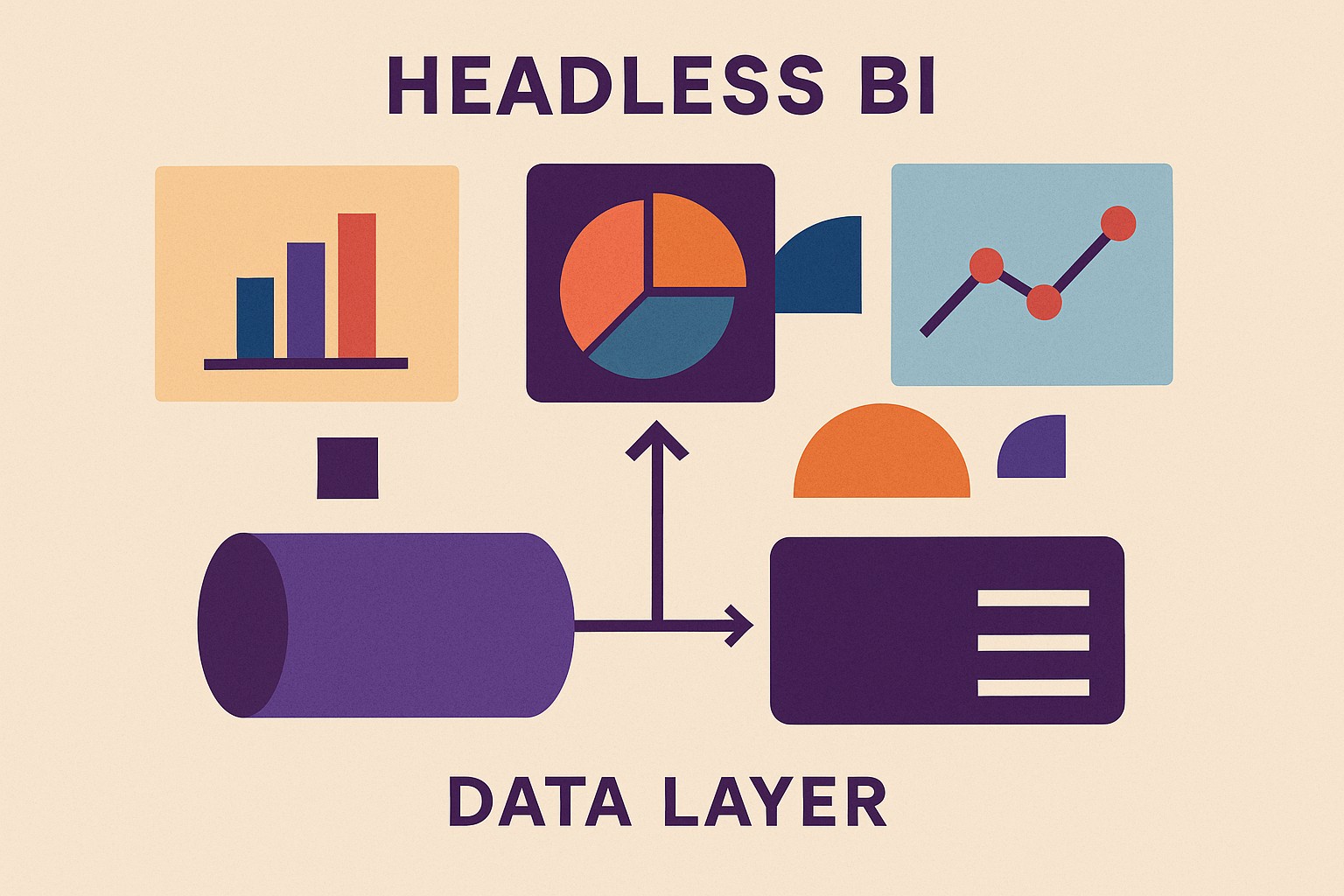
Headless business intelligence represents a shift in how analytic data is produced, served, and consumed. At its core, it decouples the analytics backend — where data is modeled, transformed, and stored — from the frontend experiences that render dashboards, reports, and insights. This architectural separation is typically realized through an API-first approach, where data products expose stable data contracts via REST or GraphQL endpoints, enabling a variety of consumer applications to fetch exactly what they need without inheriting UI constraints. By treating the analytics layer as a reusable service, organizations can build multiple frontends—web apps, mobile apps, embedded analytics within partner platforms—without re-implementing the data logic each time.
Beyond technical dekoupling, headless BI emphasizes governance, security, and flexible data delivery. A semantic layer or data catalog sits above raw data to define business metrics, dimensions, and hierarchies once, so every consumer uses consistent definitions. This reduces metric drift across teams and products. Real-time or near real-time data flows, event streaming, and modern data warehouses provide the foundation, while frontends rely on lightweight clients that render visuals, perform client-side composition, and apply user-specific access controls. The result is a system where the insight engine remains centralized and auditable, while presentation and embedding become modular and scalable.
How headless BI works in practice
The practical stack starts with a data foundation: a data warehouse or lakehouse that stores raw data, a transformation layer that shapes it into business-ready facts, and a semantic model that exposes consistent metrics. On top of this, developers expose APIs and data contracts that front-end teams or embedded applications can consume. Frontends—whether a custom dashboard, a partner portal, or an embedded analytics frame—pull data through these APIs, render visual components, and compose experiences with minimal coupling to the underlying data storage. Caching, authentication, and rate limiting are applied at the edge to ensure performance, security, and reliability across multiple tenants and devices.
Operational considerations matter as well. Data contracts must be versioned, and semantic definitions should be governed to prevent metric drift when data sources evolve. Authentication and authorization patterns—such as token-based access, least-privilege scopes, and row-level security—help preserve data governance in multi-tenant environments. Deployment strategies favor incremental changes, feature flags for new metrics, and automated checks that validate API responses against predefined contracts. In practice, teams adopt a modular front-end architecture, often leveraging micro frontends or component libraries that can be embedded into distinct products while sharing a single analytics backend.
Benefits for developers and product teams
Adopting a headless BI approach unlocks greater flexibility and speed. Developers gain autonomy to design dashboards, reports, and data stories without being constrained by a fixed front-end. Product teams can iterate on how insights are packaged and delivered, tailoring experiences to different user roles, domains, or business units. This separation also supports brand consistency and cross-product analytics, since the same metrics and semantic definitions are consumed by multiple applications rather than recreated in each context.
- Consistency of metrics and definitions across all products and teams, reducing reconciliation efforts and decision-making friction.
- Faster front-end development and iteration cycles, as the analytics layer becomes a reusable service rather than a bespoke component for each app.
- Improved embed-ability and white-labeling capabilities, enabling partners and customers to integrate analytics with minimal customization.
- Reduced tech debt and smoother future migrations, since data modeling, governance, and API contracts are managed centrally.
In practice, these benefits translate into shorter time-to-insight for users and more predictable delivery for engineering and product teams. The decoupled model encourages experimentation with new visualization paradigms, supports governance auditable trails for regulatory compliance, and enables non-technical stakeholders to explore data through governed, self-serve interfaces while preserving centralized control over data quality and security.
Use cases and practical examples
Headless BI shines in scenarios where multiple products, channels, or partners need access to the same analytics without duplicating logic. Common use cases include embedded analytics in SaaS applications, where customers gain customized dashboards that align with their workflows; partner portals that showcase joint KPI dashboards; internal product dashboards that empower product managers to monitor feature adoption and performance; and customer-facing portals that offer data-driven insights as part of a service. This approach also supports product-led growth strategies by enabling free or trial experiences to surface meaningful metrics that illustrate value early in the customer journey.
- Embedded analytics inside a SaaS platform, with white-labeled visuals and role-based access to sensitive data.
- Customer and partner portals that present trustable metrics, trend analyses, and anomaly alerts without exposing backend complexities.
- Internal dashboards for product, sales, and support teams that share a unified metric taxonomy while enabling customized views.
- Developer-friendly dashboards that expose data via APIs for experimentation, data science work, or rapid prototyping of new insights.
When implemented well, headless BI supports consistent storytelling across experiences while granting teams the freedom to optimize interfaces for specific user needs. It also enables organizations to scale analytics without re-architecting frontend layers, ensuring that new products or acquisitions can immediately adopt the same analytic vocabulary and data quality standards.
Considerations, challenges, and best practices
Adopting headless BI is not merely a technology shift; it requires disciplined governance, clear contracts, and a thoughtful approach to performance. Key considerations include establishing a stable semantic model that defines metrics, dimensions, and hierarchies, as well as setting up robust data contracts that govern API shapes, versioning, and backward compatibility. Security is paramount in multi-tenant environments, so teams should implement fine-grained access controls, data masking where appropriate, and auditable logs of data access and changes. Performance strategies such as caching, query optimization, and thoughtful use of pre-aggregations can help ensure responsive experiences across embedded and consumer-facing apps.
- Define a clear data contract and semantic model that evolves with governance rules, ensuring consistency across every consumer.
- Choose API patterns and authentication methods that align with your architecture, including token scopes, rate limits, and tenant isolation.
- Invest in caching strategies and pre-aggregation to optimize latency for common queries and dashboards.
- Establish data quality practices, monitoring, and change management to prevent metric drift and broken dashboards.
Finally, plan for the organizational changes that accompany headless BI adoption. Cross-functional teams should collaborate on data governance, UX design for analytics, and embedding strategies. Tooling choices should balance flexibility with maintainability, ensuring that the analytics service remains scalable as the number of consumers grows and as new data sources are introduced. With careful design and ongoing collaboration, headless BI can deliver a resilient, scalable analytics experience that accelerates decision-making across the organization.
FAQ
What distinguishes headless BI from traditional BI approaches?
Headless BI decouples the data processing and modeling layer from the presentation layer, exposing analytics through APIs rather than enforcing a fixed dashboard or UI. This enables multiple frontends and embedded experiences to share a single, governed data model, while traditional BI often binds analytics to a single, monolithic front-end with limited customization and embedding capabilities. The result is greater flexibility, reuse, and consistent metrics across products, alongside improved speed to deliver tailored insights to different audiences.
What are the core components of a headless BI stack?
A typical headless BI stack includes a data foundation (data warehouse or lakehouse), a semantic layer or metadata catalog for metrics and definitions, an API layer that exposes data contracts, authentication and authorization services, and frontend or embedding capabilities that render visuals and dashboards through client apps. Optional components may include data governance tools, caching layers, and event-driven data pipelines to support real-time insights.
How do you maintain data governance and security in a headless BI setup?
Data governance in headless BI is anchored by a centralized semantic model, versioned data contracts, and role-based access controls that enforce who can view which data. Security is reinforced through tenant isolation, token-based authentication, auditing of data access, and masking or redaction for sensitive information. Regular reviews of definitions, data quality monitoring, and automated checks help prevent drift and ensure that all consuming applications adhere to approved data policies.
What are common pitfalls when adopting headless BI?
Common challenges include underinvesting in data contracts and governance, which leads to metric drift and inconsistent insights; overcomplicating the semantic model, making it hard for teams to use; and underestimating the importance of performance optimization, resulting in slow dashboards for embedded experiences. Another frequent issue is attempting to boil the ocean by exposing too many endpoints without clear prioritization, which can create maintenance overhead and confusion for developers.
How can headless BI support product-led growth and partner ecosystems?
By providing embeddable analytics with consistent metrics, organizations can demonstrate value within their product experiences and partner portals. Headless BI enables rapid customization of dashboards to align with customer workflows, facilitates white-labeling for third-party products, and supports scalable onboarding with self-serve analytics. This combination helps accelerate adoption, improves customer success, and strengthens partner relationships by delivering measurable insights that matter to users at every step of the journey.