Now Reading: Kanban vs Scrumban: Which Agile Variant to Use?
-
01
Kanban vs Scrumban: Which Agile Variant to Use?

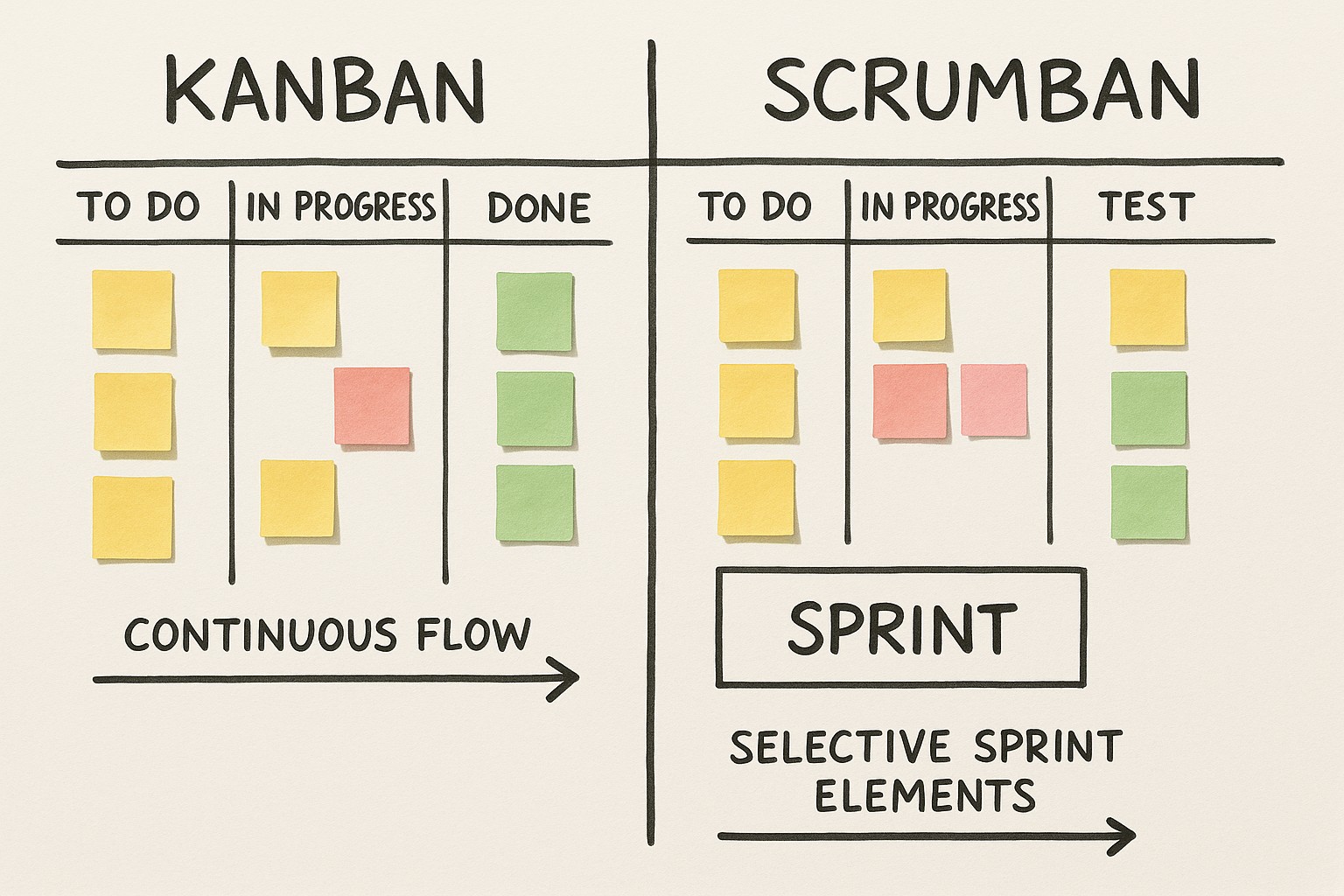
Kanban and Scrumban in context
Kanban originated in manufacturing and was adopted by software development and knowledge work to visualize work, limit work in progress (WIP), and optimize flow. It treats work as a continuous stream that can be pulled through a board, with explicit policies governing how work enters and leaves each stage. As an agile variant, Kanban is admired for its flow-based discipline, its minimal ceremony overhead, and its ability to adapt to existing processes without requiring a full process retooling.
Scrumban emerged as a practical hybrid for teams that needed Scrum’s planning cadence and backlog structure but wanted Kanban’s flexibility to manage changing priorities and to optimize flow. In Scrumban, teams often retain a backlog, planning events, and retrospective opportunities, but apply Kanban-inspired flow rules, WIP limits, and pull-based work at the execution level. The goal is to strike a balance between predictability and adaptability, especially in environments where requirements evolve frequently or where work types vary widely between maintenance, bugs, and new features.
- Kanban emphasizes continuous flow, visualization of work, and process improvement without fixed iteration boundaries.
- Scrumban blends Scrum ceremonies with Kanban flow to provide planning cadence while preserving adaptability to changing priorities.
- Both approaches rely on WIP limits and visual boards, but the way planning, reviews, and changes are scheduled differs.
- The choice between Kanban and Scrumban often hinges on desired predictability, cadence tolerance, and the organization’s change-management posture.
How Kanban works in practice
A Kanban implementation centers on a visual board that maps work from discovery to completion. Columns typically reflect states such as Backlog, In Progress, In Review, and Done, with WIP limits that cap how many items can occupy a column at once. Teams track metrics like cycle time and throughput to understand flow and identify bottlenecks, thereby enabling incremental process improvements without triggering major reorganizations.
Work is pulled through the system based on capacity and policy. No fixed iterations are required; teams prioritize transparency and quick feedback loops. Daily standups, when they occur, focus on flow issues rather than task-level status, and governance is achieved through explicit policies, such as definition of ready and definition of done, as well as agreed-upon service levels. Over time, small refinements to the board, WIP limits, and workflow stages help improve predictability and reduce context switching.
What Scrumban changes: bridging Scrum and Kanban
Scrumban preserves much of Scrum’s structure—backlogs, planning, and retrospectives—while incorporating Kanban’s flow discipline to increase adaptability. In practice, teams may hold lighter planning cadences, refine the backlog continuously, and use a Kanban board to manage day-to-day work. Scrumban often introduces explicit WIP limits alongside planning events, so teams can decide when to pull new work and how to balance maintenance work with feature development.
Implementation patterns vary, but common elements include: a prioritized backlog that informs upcoming work, cadence-based planning sessions (which may be shorter or more frequent than traditional Scrum sprints), and retrospectives that focus on flow and policy improvements. Scrumban allows teams to adjust planning frequency, size of work items, and the emphasis on predictability versus adaptability depending on project needs. This flexibility is especially valuable in product development environments where priorities can shift rapidly but a level of ceremony helps coordinate multiple stakeholders.
Choosing between Kanban and Scrumban: key considerations
Selecting between Kanban and Scrumban begins with understanding the team’s appetite for planning, cadence, and change management. If your priority is continuous delivery with minimal ceremony and you want to optimize flow under a steady demand, Kanban provides a lean, adaptable framework. If your organization benefits from regular planning, clear backlog management, and structured review cycles but still requires flexibility in execution, Scrumban offers a practical middle ground that can evolve with the team.
- Work predictability and planning cadence: prefer Kanban when demand is steady and planning overhead should be minimal; prefer Scrumban when you need periodic alignment and structured backlog refinement.
- Team size and collaboration style: smaller, autonomous teams may thrive with Kanban; larger teams or programs with multiple stakeholders may benefit from the coordination provided by Scrumban’s planning and reviews.
- Industry and regulatory requirements: environments demanding formal change control and traceability may lean toward Scrumban; teams with looser governance can leverage Kanban’s lightweight flow.
- Change management and risk tolerance: if the organization values gradual change and continuous improvement, Scrumban’s ceremonies can ease adoption; if stability and minimal disruption are paramount, Kanban’s lean approach fits better.
Implementation patterns and cadences
Organizations typically start with a clear visualization of existing work and a small, incremental change program. For Kanban, the initial steps may include mapping the current workflow to a board, defining WIP limits, and establishing basic policies around prioritization and definition of done. For Scrumban, teams often begin with a lightweight backlog, introduce a planning cadence, and layer Kanban flow rules on top of the existing Scrum practices. The cadence chosen should reflect the team’s delivery rhythm, stakeholder expectations, and risk tolerance, with a bias toward gradual improvement rather than abrupt process shifts.
As teams mature, cadences can be tuned to balance predictability with flexibility. Regular reviews focus on flow metrics, policy updates, and backlog health. For Kanban, reviews tend to emphasize flow optimization and WIP management, while for Scrumban, reviews may also address backlog readiness and planning effectiveness. Regardless of the approach, the core objective remains the same: deliver value smoothly, learn from the data, and adapt the process to evolving work demands.
Metrics and governance
Both Kanban and Scrumban rely on data to guide decision-making, but the emphasis differs. Kanban places strong emphasis on flow metrics like cycle time, lead time, and WIP utilization, using these indicators to identify bottlenecks and drive process improvement. Governance in a Kanban setup tends to be lightweight, focusing on policies, service level agreements, and visual transparency across the board. Scrumban introduces planning and review cadence that adds an explicit governance rhythm—backlog grooming, sprint-like planning boundaries (even if shorter or more flexible), and retrospective learning that feeds back into process changes. The governance model blends structured alignment with a continuous improvement mindset, supporting teams as they adjust to changing priorities while maintaining traceability of decisions.
Organizations should also consider role clarity, decision rights, and change-control practices as part of governance. Clear ownership for backlog grooming, policy maintenance, and board design helps prevent drift. In both approaches, keeping a living set of policies—definition of ready, definition of done, acceptance criteria, and escalation paths—ensures consistent delivery and reduces rework. Metrics should be actionable, accessible, and tied to business outcomes, not just process efficiency, to maintain executive sponsorship and team motivation.
Practical adoption and tooling
When planning practical adoption, leaders should outline a staged path: pilot teams, measurable goals, and a clear exit or expansion strategy. In Kanban pilots, success can be measured by reduced cycle time, smoother handoffs, and improved on-time delivery without major changes to ceremonies. In Scrumban pilots, success might include improved planning reliability, more accurate backlog readiness, and a measurable decrease in rework due to better alignment between demand and capacity. Tooling should support visual boards, backlog management, and metrics dashboards, with emphasis on ease of access and low friction for the teams involved.
To maximize impact, teams should start with a concise, shared understanding of policies (definition of ready, definition of done, WIP limits) and ensure it is visible on the board. Training and coaching can accelerate adoption, but the best guidance is practical experimentation: run short pilots, collect data, and adjust the process accordingly. Remember that the aim is to improve value delivery, not to enforce rigid conformity; the most successful teams tailor Kanban or Scrumban to their specific context while maintaining the core principles of flow, visibility, and continuous improvement.
- Board design aligned to value streams and stakeholder needs
- Well-defined WIP limits and policies to prevent bottlenecks
- Clear backlog management practices and lightweight planning cadences
- Simple, accessible metrics and regular review of flow and throughput
FAQ
Is Kanban always better than Scrumban for every team?
No. Kanban can be a strong choice for teams that value continuous delivery with minimal ceremony and clear flow. Scrumban suits teams that benefit from some Scrum structure—planning, backlog grooming, and retrospectives—while still needing flexibility in execution. The right choice depends on your goals, culture, and the level of coordination required across stakeholders.
Can a team switch from Kanban to Scrumban, or vice versa, without disruption?
Yes, in many cases. Because both approaches emphasize visibility and flow, teams can adopt Scrumban gradually by adding planning cadences and retrospectives to an existing Kanban setup, or by adopting Kanban flow rules within a Scrum framework. A staged transition with clear policy changes, pilot teams, and data-driven evaluation tends to minimize disruption and maximize learning.
How do you start a Scrumban pilot effectively?
Start with a small, cross-functional team and a prioritized backlog. Establish a lightweight planning cadence, define WIP limits, and map the current workflow to a board. Implement a simple backlog grooming routine and a retrospective focused on flow improvements. Collect metrics such as cycle time and lead time, review outcomes with stakeholders, and iterate on board design, policies, and cadence until the team consistently delivers value with improved throughput.