Now Reading: Rule-Based AI vs Neural Networks: Two Approaches to AI
-
01
Rule-Based AI vs Neural Networks: Two Approaches to AI

Rule-Based AI: Definition and Core Concepts
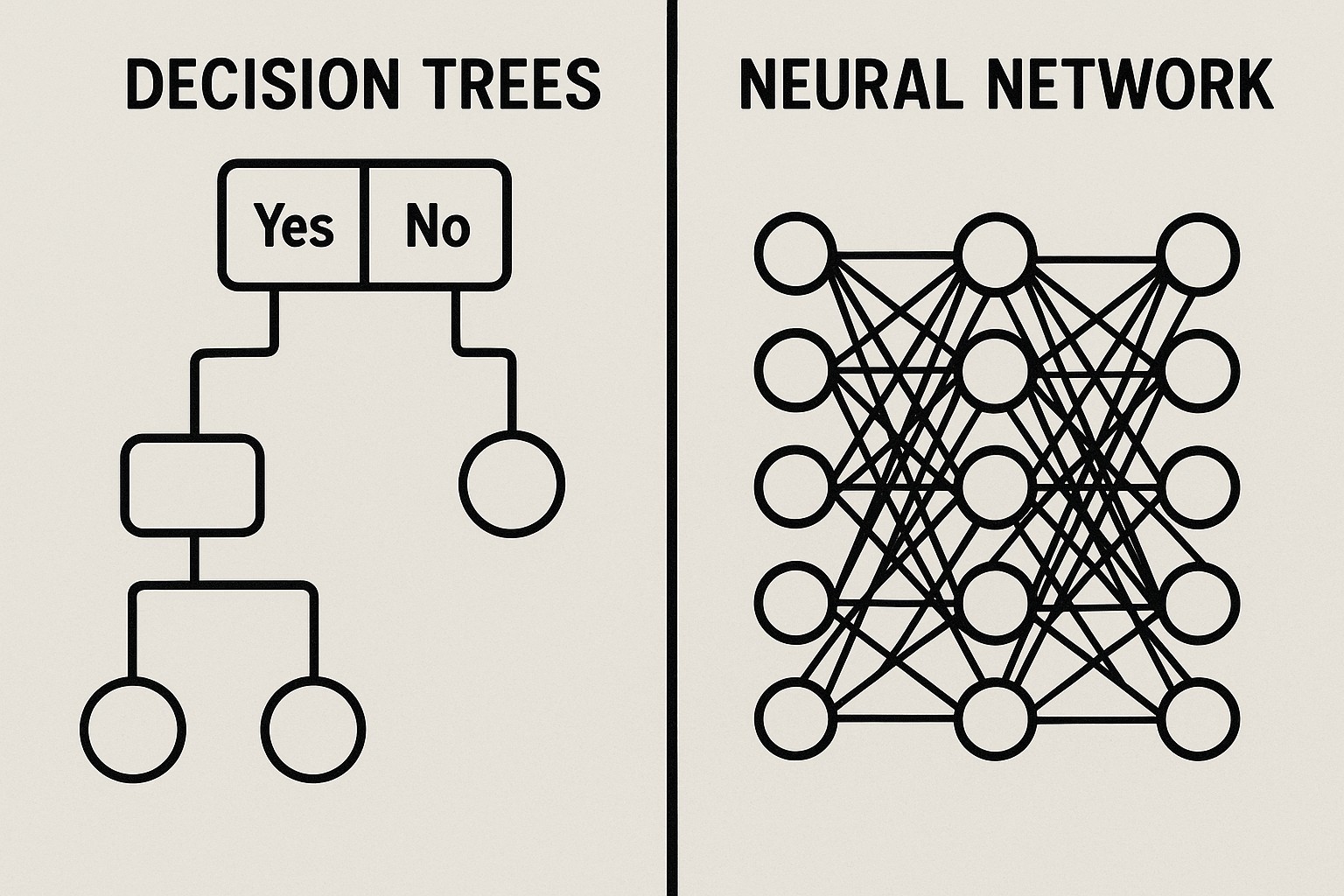
Rule-based AI, often described as symbolic or expert-system AI, encodes domain knowledge as explicit rules, logic, and structured representations. It relies on if-then statements, decision trees, and production rules that map inputs to outputs in a deterministic fashion. The objective is to produce predictable behavior that can be audited, tested, and adjusted through governance processes. In industries with stringent compliance requirements, this approach offers a clear trail from data input to decision, which can simplify validation and oversight.
Because the rules are explicit, organizations can reason about why a particular decision was made, which data influenced it, and how to modify behavior as policies change. Rule-based systems are particularly effective in well-defined, narrow domains where human expertise has already identified the relevant conditions and outcomes. They also enable modular design, allowing separate rule sets to be composed or swapped to reflect evolving requirements without retraining a model from scratch.
Typical development and maintenance cycles for rule-based AI involve knowledge engineering, rule validation, and ongoing governance. While this can yield strong interpretability and control, complexity grows quickly as the number of rules expands or when rules interact in unexpected ways. Organizations must invest in change control, versioning, and testing to prevent rule conflicts and ensure the system remains aligned with policy and regulatory standards.
- Deterministic outputs that are easy to reproduce
- High interpretability and auditability for stakeholders
- Explicit domain knowledge captured as rules
- Low data requirements and simple data pipelines
- Modular, auditable governance with clear versioning
- Limited adaptability to novel or unstructured situations
Neural Networks: Data-Driven Learning
Neural networks, especially deep learning architectures, learn representations and decision surfaces directly from data. They adjust many parameters across multiple layers to minimize error, often through large-scale optimization techniques such as gradient descent. This data-centric approach excels at discovering complex patterns, nonlinear relationships, and subtle interactions among features that are difficult to codify by hand. It is particularly powerful for perception tasks, forecasting, and decision-making in environments with noisy or high-dimensional data.
These models depend on substantial data—labeled for supervised learning or organized in ways suitable for unsupervised or self-supervised learning—and typically require significant computational resources for training and inference. With enough data and careful architecture selection, neural networks can generalize to new, unseen examples and adapt to variations in input. However, their behavior is often opaque, because decisions arise from distributed representations across many neurons rather than explicit, human-readable rules.
Deploying neural networks also demands rigorous data governance, monitoring for drift, and strategies to mitigate bias and unfairness. Data quality, labeling accuracy, and class imbalance can all influence performance. Ongoing research in explainable AI, calibration, and model monitoring aims to address these challenges, but the fundamental trade-off remains: strong predictive power with imperfect interpretability versus transparent, rule-governed behavior.
- Data-driven pattern recognition with high capacity
- Ability to handle high-dimensional inputs and unstructured data
- Adaptability to new data without rewriting logic
- Substantial data and compute requirements
- Potential opacity and explainability challenges
- Opportunities for transfer learning and continual improvement
Key Differences and Trade-offs
Rule-based AI and neural networks represent two ends of a spectrum in terms of interpretability, data requirements, and adaptability. Rule-based systems offer clear, human-readable logic and straightforward auditability but can struggle to scale when faced with complex, noisy, or evolving environments. Neural networks excel at absorbing large amounts of data to model intricate patterns, yet their decisions can be difficult to interpret, and maintaining data quality is critical to prevent biased or brittle outcomes. The optimal choice often depends on the domain, risk tolerance, and the availability of data and expertise.
In practice, the choice is rarely binary. Many organizations pursue hybrid architectures that delegate well-defined, rule-governed decisions to a rule-based component and rely on neural networks for perception, pattern recognition, or predictive tasks where explicit rules are impractical. The governance model for each approach also differs: rule-based systems emphasize change control and traceable logic, while neural networks prioritize data governance, dataset provenance, and monitoring for drift and fairness. Balancing these dimensions is a central challenge in modern AI program design.
For decision-making systems that touch on safety, ethics, or regulatory compliance, the ability to explain why a decision was made often drives stakeholder trust and acceptance. Rule-based components can provide this explainability directly, while neural networks may require additional explainability tools and carefully designed evaluation protocols. As organizations mature, they increasingly adopt hybrid patterns, modularizing responsibilities to leverage the strengths of both approaches while mitigating their weaknesses.
Rule-based systems deliver auditable reasoning; neural networks deliver adaptable perception. The right mix often yields the most durable competitive advantage.
Scenarios and Use Cases
Understanding the strengths and limitations of rule-based and neural network approaches helps teams design systems that align with business goals, regulatory demands, and data availability. The following scenarios illustrate how organizations typically allocate functions across approaches and when hybrid designs shine.
- Regulatory compliance and audit-heavy decisions where the rationale must be fully traceable, such as loan approvals, insurance underwriting, or tax reporting.
- Domains with well-established rules and limited variability, where exceptions can be enumerated and tested, such as basic eligibility checks or policy enforcement.
- Environments with scarce labeled data or where data gathering is costly, enabling reliable rule coverage without large datasets.
- Applications requiring transparent decision trails for regulators, customers, or internal governance, where explainability is a core requirement.
- Hybrid systems that govern critical safety or ethics-sensitive components with rules while deploying neural networks for sensing, perception, or pattern discovery in the same workflow.
Implementation Considerations and Hybrid Approaches
In many real-world settings, combining rule-based logic with neural networks delivers practical benefits. A hybrid architecture can delegate deterministic, auditable decisions to rules while using neural networks to handle perception, uncertain inputs, or noisy data. This separation can simplify validation, reduce brittle failures, and improve overall reliability. Implementers should design clear interfaces between components, define confidence thresholds for routing decisions, and establish governance processes that cover both rule and model changes.
Key considerations include data quality, model monitoring, latency, and the governance lifecycle. Rule-based components are typically fast and deterministic, with straightforward versioning and testing. Neural networks may require periodic retraining to reflect new data distributions, with monitoring focused on drift, calibration, and fairness. Hybrid designs also introduce integration challenges—ensuring consistent data formats, aligning decision semantics, and managing failure modes when one component disagrees with the other.
def decide(input_data):
    if rule_based_condition(input_data):
        return rule_based_decision(input_data)
    else:
        nn_output = neural_model.predict(input_data)
        return postprocess(nn_output)
Designers should establish explicit routing logic, test both components under diverse edge cases, and implement robust fallback paths. Documentation should cover not only the rules and model behavior but also data lineage, rule provenance, and model version histories. Security considerations—such as access control to rule editors and model developers—are essential to maintain trust and prevent unauthorized changes.
Practical Takeaways for Businesses
For organizations aiming to balance predictability with adaptability, a pragmatic approach is to start with the governing questions: what decisions must be explained to stakeholders, what data is available, and how critical is the outcome. In many cases, a phased path emerges: begin with rule-based logic to establish baseline compliance and transparency, gradually introduce neural components to handle areas where patterns are strong but rules are hard to enumerate, and monitor performance closely to detect drift or misalignment with policy.
Invest in data governance, documentation, and testing frameworks that support both rule sets and learned models. Establish clear ownership, version control, and a lifecycle that accounts for updates to regulations, business policies, and data collection practices. When data is scarce or the cost of errors is high, prioritize rule-based coverage and specify a path for incremental neural integration that preserves transparency and accountability. The most successful programs treat rule-based systems as safeguards and governance rails, while neural networks drive capability and scalability.
FAQ
What is rule-based AI?
Rule-based AI uses explicit, human-crafted rules and logic to map inputs to outputs. It emphasizes interpretability, traceability, and deterministic behavior, making it easier to audit decisions and ensure compliance in well-defined domains.
What are neural networks and how do they learn?
Neural networks learn by adjusting many interconnected parameters across layers based on data. Through training, they identify patterns and representations that enable them to make predictions or decisions from complex, high-dimensional inputs, often outperforming hand-coded rules in perception and pattern recognition tasks.
When should a business prefer a rule-based approach over a neural network?
Consider a rule-based approach when decisions require clear justification, regulatory auditability, and stable, well-defined rules with limited variability. If data is scarce or the cost of incorrect decisions is high due to legal or safety implications, rule-based systems provide strong governance and reliability.
Can rule-based and neural network approaches be combined?
Yes. Hybrid architectures route deterministic decisions to rule-based components and leverage neural networks for perception, forecasting, or pattern discovery. This combination can deliver both transparency and adaptability, provided there are clear interfaces, governance for both components, and robust monitoring of all decision pathways.
What about data privacy and governance in AI systems?
Data privacy and governance are essential across both approaches. Organizations should enforce data minimization, access controls, audits of data lineage, and bias/ fairness assessments. In rule-based parts, governance emphasizes rule provenance and change control; in neural parts, it emphasizes dataset quality, labeling processes, and ongoing monitoring for drift and unintended consequences.