Now Reading: Top API Management Platforms and Their Features
-
01
Top API Management Platforms and Their Features

Overview of top API management platforms
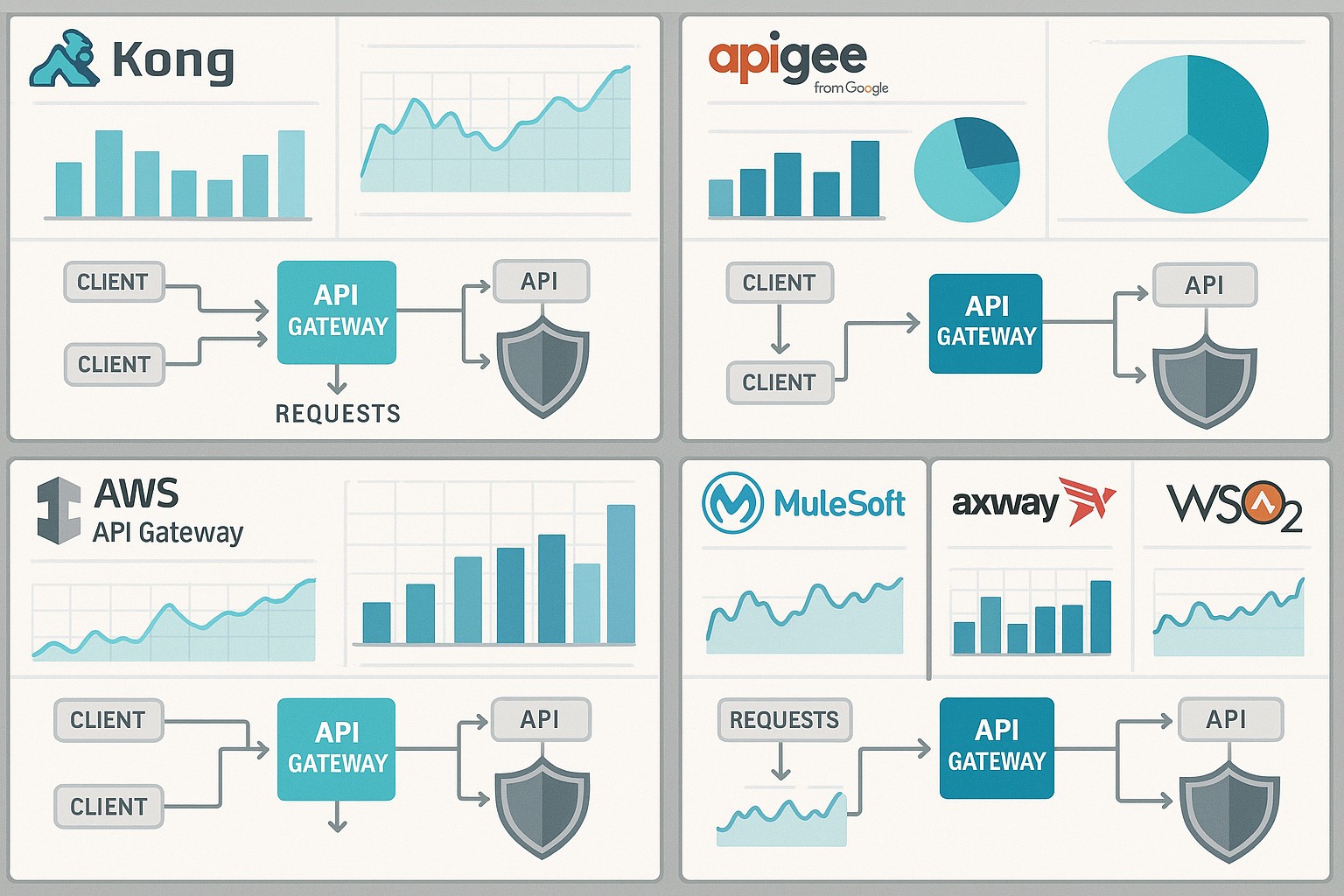
In today’s API-driven economy, organizations rely on robust API management platforms to secure, publish, monitor, and monetize their digital services. A well-chosen solution can unify security policies, provide deep analytics, and streamline developer onboarding across ecosystems, cloud environments, and on‑premises deployments. When evaluating api management solutions and api management platforms, teams typically weigh governance maturity, policy flexibility, developer experience, and integration with existing identity, CI/CD, and telemetry pipelines. The goal is to enable rapid API delivery without compromising security or reliability.
Across leading platforms, core capabilities include policy-driven security, developer portals, usage analytics, lifecycle management, and governance tooling. Interoperability with gateways, load balancing, and service meshes matters, as does the ability to operate in multi-cloud, on-premises, or hybrid configurations. This article surveys prominent options, highlighting how they address security, analytics, developer experience, and operational efficiency, with an eye toward large organizations that demand scale, compliance, and predictable SLAs. The discussion centers on features that matter for api management platforms, such as policy enforcement, monitoring, and ecosystem tools that help teams design, publish, and monetize APIs efficiently.
| Platform | Best for | Core strengths | Simplified deployment model |
|---|---|---|---|
| AWS API Gateway | Cloud-native, serverless API programs | Tight AWS integration, scalable edge gateway, strong security controls | Fully managed |
| Apigee (Google Cloud) | Global API programs with policy-driven governance | Rich policy engine, analytics, monetization, multi-cloud | Hybrid/multi-cloud available |
| Azure API Management | Microsoft-centered environments and hybrid apps | Policy framework, developer portal, deep Azure integration | Cloud-hosted or managed |
| Kong | Open ecosystem, hybrid/multi-cloud edge | Extensible gateway with plugins, high performance | Hybrid or cloud |
AWS API Gateway
AWS API Gateway is a natural choice for teams already invested in the AWS ecosystem. It provides a scalable, fully managed gateway for creating, publishing, and securing APIs at any scale. The service integrates seamlessly with IAM, AWS WAF, Shield, and CloudWatch, enabling centralized access control, threat protection, and observability. API Gateway works well in serverless architectures (often paired with Lambda), but it also supports REST and WebSocket APIs for more traditional API patterns.
Security and governance are foundational strengths. Fine-grained authorization through IAM roles and policies, resource-based permissions, and usage plans help enforce rate limits and quotas. Built-in support for mutual TLS, custom domain names, and comprehensive metrics ensures operational visibility. For developer experience, AWS API Gateway offers managed documentation and a developer portal that simplifies onboarding for external developers, partner ecosystems, or internal teams. The platform’s tight integration with AWS Analytics and X-Ray enables end-to-end tracing and performance monitoring, which is critical for identifying latency sources and optimizing throughput.
- Policy-driven security with IAM, Lambda authorizers, and mutual TLS
- Integrated threat protection via AWS WAF and Shield
- Comprehensive monitoring with CloudWatch metrics and X-Ray tracing
- Serverless-first design with Lambda and event-driven backends
- Developer portal for streamlined onboarding and documentation
Apigee (Google Cloud)
Apigee stands out for enterprise-grade API governance, robust policy orchestration, and extensive analytics capabilities. It supports hybrid and multi-cloud deployments, enabling organizations to manage APIs that cross on‑premises data centers and multiple public clouds from a unified control plane. The platform’s monetization features are particularly attractive to organizations that expose APIs as products, allowing tiered access, metering, and revenue sharing across partners and developers.
Policy management is central to Apigee’s value proposition. Rich, composable policies cover security, mediation, transformation, and routing, allowing teams to implement complex API logic without custom code. The analytics workspace offers deep insights into usage patterns, error rates, and performance across environments, which informs capacity planning and developer engagement strategies. For developer experience, Apigee provides a polished portal with API catalogs, interactive consoles, and self-service registration that supports external ecosystems and partner networks.
- Policy-driven governance and transformation with a mature policy engine
- Robust analytics, reporting, and monetization capabilities
- Hybrid/multi-cloud deployment enablement with centralized control plane
- Developer portal designed for enterprise-scale onboarding
Azure API Management
Azure API Management is well-suited for organizations deeply embedded in the Microsoft stack or pursuing hybrid cloud strategies. It provides a comprehensive gateway, developer portal, and management plane with strong integration to Azure Active Directory, Key Vault, and the broader Azure services. This tight coupling helps organizations implement secure API access, policy-based routing, and automated publishing workflows within familiar tooling and processes.
Security and policy enforcement are core strengths. The policy framework supports transformations, validation, caching, and rate limiting, while the developer portal offers customizable documentation, code samples, and interactive testing. Global reach is facilitated by multi-region deployments, allowing for reduced latency and compliance with regional data requirements. Analytics cover API usage, health, and performance, contributing to proactive operational management and capacity planning.
- Policy-driven gateway with robust transformation capabilities
- Built-in developer portal tailored for enterprise teams
- Strong Azure integration for identity, key management, and monitoring
Kong (Kong Enterprise / Kong Gateway)
Kong combines a lightweight, high-performance gateway with an extensive plugin ecosystem, making it a flexible choice for organizations seeking control over deployment topology and customization. It supports cloud-native deployments, on‑premises, and hybrid configurations, and it integrates well with service meshes and Kubernetes environments. The open‑source core coupled with an enterprise layer gives teams access to advanced security, rate limiting, caching, and analytics without vendor lock-in.
Deployment flexibility and extensibility are notable advantages. Kong’s plugin architecture enables teams to add authentication, transformation, observability, and traffic control functionality without rewriting client code. Hybrid deployment options and a growing ecosystem of integrations help organizations craft API networks that align with developer ecosystems, data sovereignty requirements, and performance objectives. The developer experience benefits from a streamlined portal and good support for API design and cataloging workflows.
- High-performance gateway with broad plugin ecosystem
- Extensibility for authentication, transformations, and metrics
- Hybrid/cloud deployments suited to service mesh and Kubernetes
MuleSoft Anypoint Platform
MuleSoft Anypoint Platform is positioned for API-led connectivity, enabling organizations to design, build, run, secure, and analyze APIs and integrations from a unified platform. It emphasizes the end-to-end lifecycle of APIs, including design in Exchange, governance via the Design Center, and policy enforcement through a centralized runtime. This approach is especially compelling for enterprises aiming to orchestrate a large portfolio of APIs and integrations across multiple teams and business units.
Security, observability, and governance are reinforced through policy enforcement, threat protection, and centralized monitoring. Anypoint’s strength lies in its combined focus on API design and integration patterns, allowing developers to create API-led architectures that streamline data flows between SaaS apps, on‑premises systems, and cloud-native services. While it may require more governance overhead than some cloud-native gateways, it delivers significant value for organizations pursuing a cohesive API economy and strong programmatic control over API contracts and usage.
FAQ
What is API management and why is it important?
API management is the set of processes and tools for publishing, securing, monitoring, and governing application programming interfaces. It matters because APIs are the primary interface through which internal and external developers access services, data, and functionality. A mature API management approach helps ensure security, reliability, and performance while enabling scalable developer ecosystems and monetization opportunities.
How should security be evaluated when selecting an API management platform?
Security evaluation should cover authentication and authorization models, token management, threat protection, rate limiting, data encryption at rest and in transit, and integration with identity providers. Look for features like mutual TLS, OAuth 2.0, OpenID Connect, WAF integration, and policy-driven access controls, as well as governance capabilities to enforce consistent security across APIs and environments.
What deployment options are typically available for API management platforms?
Common deployment models include fully managed cloud services, on‑premises installations, and hybrid configurations that span on‑premises and cloud environments. Hybrid deployments are particularly valuable for regulated workloads or data residency requirements, while cloud-native options often offer faster time-to-value and reduced operational overhead.
Which platform is best for large enterprises with diverse ecosystems?
The best platform depends on existing investments, governance needs, and the desired balance between control and speed. Enterprise-friendly options such as Apigee, Azure API Management, and MuleSoft Anypoint Platform shine when multi-cloud governance, monetization, and complex policy orchestration are priorities. For organizations prioritizing performance, plugin extensibility, or Kubernetes-centric architectures, Kong is a strong contender. A careful evaluation against your organization’s security, compliance, and integration requirements will determine the best fit.