Now Reading: AR vs VR vs MR: Differences in Immersive Technologies
-
01
AR vs VR vs MR: Differences in Immersive Technologies

Overview: AR, VR, and MR in the modern enterprise
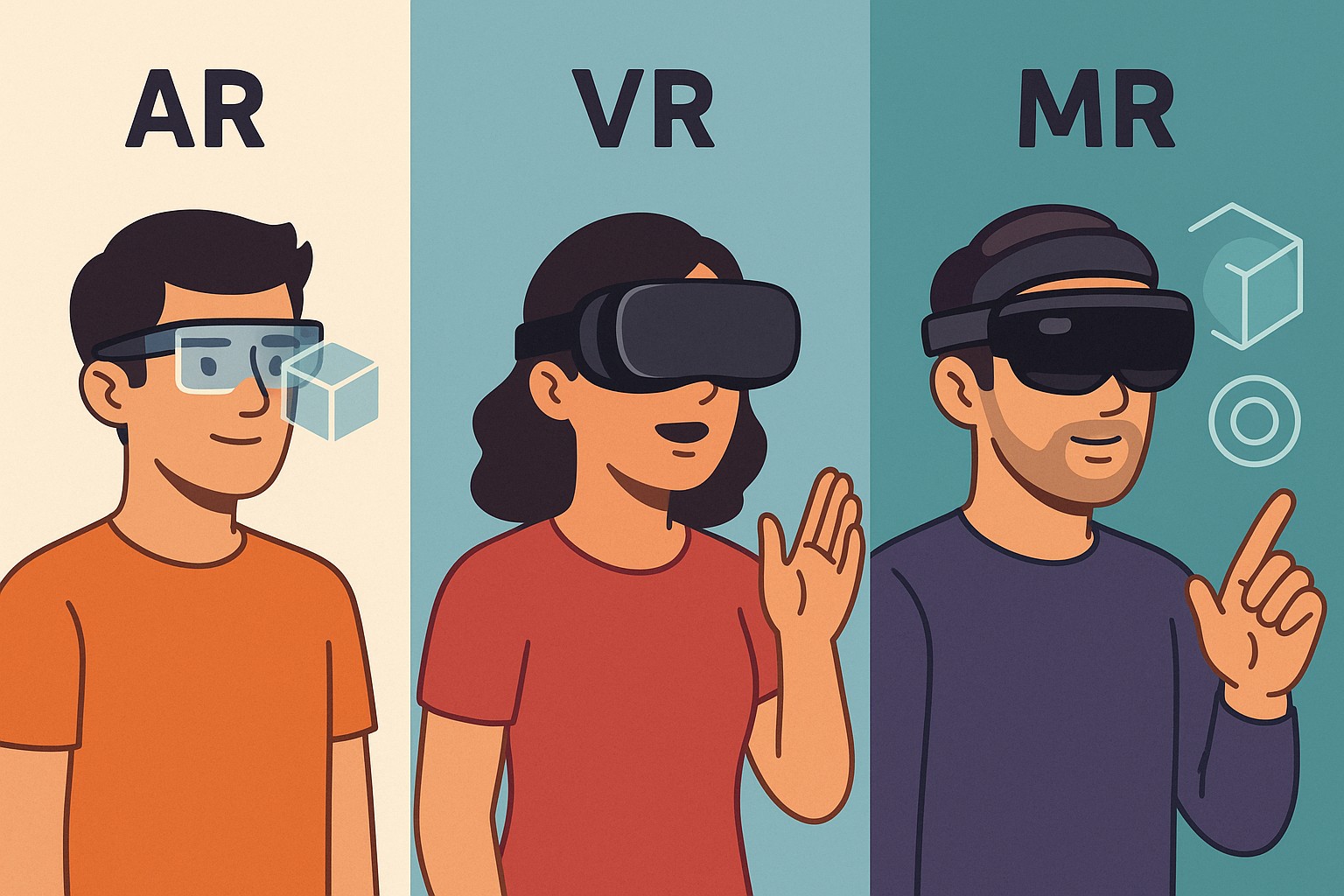
Augmented reality, virtual reality, and mixed reality together form a spectrum of immersive technologies that alter how people perceive and interact with digital content. AR adds digital information onto the real world, VR transports users into entirely synthetic environments, and MR blends real and virtual elements so they can coexist and interact in real time. Although the distinctions can be subtle, understanding where each technology excels helps executives align technical strategy with business goals. This article explains the differences, current applications, and future potential of AR, VR, and MR, with practical guidance for planning, budgeting, and governance.
In practice, organizations don’t adopt AR, VR, or MR in isolation. Rather, they choose the right tool for a given task, role, and workflow. AR is often deployed to enhance field work, maintenance, and on-site decision making by enriching real-time context. VR is typically used for safe, scalable simulation, product design iterations, and remote collaboration. MR combines the strongest aspects of both, enabling tangible interaction with digital content embedded in the real world. Each technology has distinct demands for hardware, software, data management, and user experience design, which in turn shape cost, risk, and return on investment. For enterprise teams, the goal is not to pick a single modality but to orchestrate a portfolio that improves accuracy, speed, and user adoption across processes such as navigation, troubleshooting, and training.
This guide emphasizes practical considerations for business and technology leaders. You will find concrete examples, decision criteria, and evidence-based expectations about what AR, VR, and MR can deliver today—and where they are likely to evolve in the next several years. It also highlights how “augmented reality navigation” and related capabilities can streamline operations in logistics, field service, and customer experiences, while acknowledging challenges around content authoring, interoperability, and privacy. The core message is that immersive technologies are most valuable when they are integrated with existing systems, data models, and governance frameworks, rather than treated as isolated experiments.
Augmented Reality (AR)
AR overlays digital content onto the real world, enabling users to see contextual information without losing sight of their environment. In business, AR supports decision making at the point of work, enhances situational awareness, and reduces travel and downtime by enabling remote guidance and on-device instruction. The common interface is a smart device—often a smartphone or tablet—though enterprise-grade smart glasses and headsets are increasingly common in field environments where hands-free operation matters. The foundational advantage of AR is its ability to preserve real-world context while enriching it with digital data, assets, and workflows.
For organizations pursuing AR initiatives, the design emphasis is on accuracy of registration (aligning digital overlays with the real world), intuitive interaction, and seamless data integration. AR-based navigation and guidance can shorten task cycles, improve first-time fix rates, and standardize procedures across dispersed sites. Security, content management, and privacy concerns must be addressed early, since AR often processes sensitive on-site data and enterprise knowledge in real time. Below is a concise view of typical AR capabilities and constraints to guide evaluation and planning.
- Real-time overlay of digital content onto the real world to support hands-on tasks
- Context awareness tied to location, equipment, and user role
- Discreet devices that enable mobility, with growing options for glasses and lightweight wearables
- Registration accuracy and latency requirements that impact task precision
- Data security, access control, and content lifecycle management
- Content authoring, localization, and update workflows for enterprise use
Virtual Reality (VR)
VR creates immersive, self-contained environments that replace the real world with synthetic experiences. In enterprise settings, VR is a powerful tool for training, simulation, design review, and remote collaboration. By isolating users from external distractions, VR can safely replicate complex, high-stakes scenarios—from industrial procedures to medical simulations—and measure performance with objective metrics. Additionally, VR enables rapid prototyping and visualization of products and processes, reducing the risk and cost of physical iterations. The strongest value propositions of VR arise where the cost or hazard of real-world practice would be prohibitive or impractical.
Implementing VR at scale requires careful attention to hardware refresh cycles, software pipelines, and content pipelines. Dependency on high-quality content means partnerships with content creators, simulation developers, and instructional designers becomes critical. Organizations that adopt VR effectively tend to standardize on a core platform for headsets and controllers, invest in instructional design and scenario scripting, and ensure integration with enterprise data sources and performance analytics. The following bullets summarize VR’s core strengths and typical constraints.
- Immersive, risk-free practice environments for training and certification
- High-fidelity simulation of equipment, processes, and hazardous scenarios
- Deliberate, repeatable practice with objective performance feedback
- Remote collaboration in shared virtual spaces to reduce travel
- Content development costs and the need for specialized skills and tooling
- Hardware, software, and bandwidth requirements that influence total cost of ownership
Mixed Reality (MR)
MR blends real and virtual elements so they can interact in meaningful ways within a shared space. With MR, digital content anchors to physical objects and responds to user input as if it were part of the real world. This makes MR well-suited for complex assembly, remote assistance with tactile feedback, and collaborative design reviews where physical and digital assets must coexist. Devices such as head-mounted displays with spatial mapping capabilities enable workers to see holograms anchored to real equipment, guiding procedures without removing them from their environment. MR’s practical value lies in combining situational awareness with interactive, context-rich content that adapts to changes in the physical world.
Adoption considerations for MR include robust spatial understanding, reliable hand and gesture tracking, and mature content pipelines. Successful MR programs align with workflows that demand precise alignment of virtual instructions with real objects, as well as context-aware collaboration between on-site teams and remote experts. While MR can be more demanding to deploy than AR, it often yields stronger productivity gains where hands-free, context-rich interaction is essential. The MR capabilities and constraints can be summarized as follows.
- Spatial mapping and persistent anchors that align digital content with the real world
- Gesture, gaze, and voice interactions that enable hands-free operation
- Coexistence of real and virtual elements with real-time feedback
- Complex hardware requirements and higher integration effort than AR
- Value in assembly, maintenance, and advanced remote assistance
Current applications by industry (table)
Immersive technologies are finding traction in multiple sectors, often by combining AR, VR, or MR with existing operations, data feeds, and enterprise platforms. The table below highlights representative focus areas and concrete use cases across several industries. Note that many organizations deploy more than one modality to support end-to-end workflows—from onboarding and training to in-field diagnostics and customer engagement.
| Industry | Preferred Technology | Example Use Cases | Value/Impact |
|---|---|---|---|
| Healthcare | VR and MR | Medical training simulations; MR-assisted surgery planning; remote anatomy guidance | Improved skill transfer, reduced procedure times, enhanced patient outcomes |
| Manufacturing and Field Service | AR and MR | On-site repair guidance; assembly line optimization; remote expert assistance | Faster maintenance, higher first-time fix rates, reduced travel costs |
| Logistics and Supply Chain | AR | Navigation and pick/pack assistance; inventory audits; warehouse orientation | Improved accuracy, reduced training time, streamlined operations |
| Education and Training | VR and AR | Interactive labs; immersive field trips; skill-based curricula | Engagement, standardized assessment, scalable access to expertise |
| Retail and Customer Experience | AR | Product visualization; virtual try-ons; in-store guidance | Greater conversion rates, enhanced brand storytelling, data-rich insights |
Future potential and risks
The trajectory of AR, VR, and MR over the next five to ten years points toward deeper integration with everyday workflows. The convergence of 5G networks, edge computing, advanced sensors, and AI-enabled perception will reduce latency, improve realism, and unlock more natural forms of interaction. Enterprises can anticipate more scalable authoring tools, better analytics on user behavior, and stronger interoperability standards that make it easier to move digital content across devices and platforms. This will enable more agile prototyping, faster content updates, and broader adoption at all organizational levels.
However, this future also carries risks that require proactive governance. Privacy concerns rise as AR overlays collect contextual data from environments and users. Security considerations expand because immersive devices touch sensitive enterprise systems and expose new attack surfaces. Access control, identity management, and data retention policies must be extended to support immersive modalities. Additionally, there is a need for inclusive design to ensure accessibility and to avoid creating inequities in training or customer experiences. Finally, the industry must align on standards for interoperability, measurement of ROI, and best practices for content reuse across projects and departments.
From a strategic standpoint, leaders should plan for a staged maturity path. Early steps often focus on focused pilots with clear success metrics, followed by broader scale-up that integrates immersive experiences with existing enterprise platforms such as ERP, CRM, and digital twins. The most durable programs are those anchored in real business processes, backed by data-driven decision-making, and sustained by cross-functional governance that includes IT, security, UX, and operations teams. In this light, AR, VR, and MR are not stand-alone experiments but complementary tools that can transform how organizations learn, decide, and perform in complex environments.
FAQ: What are the key differences between AR, VR, and MR?
AR overlays digital information on the real world, VR creates a fully virtual environment, and MR blends real and virtual content with interactive capabilities. The choice depends on whether you need real-time context in the field (AR), immersive practice and simulation (VR), or tightly coupled real-and-virtual collaboration (MR).
FAQ: Which technology should a company start with?
Start with a problem that benefits from context, hands-free work, or remote expertise. If the goal is to augment real-world work without isolating the user, AR is often the most practical starting point. If training, safety, or complex design is the driver, VR or MR may be more appropriate, with MR offering strong collaborative potential for ongoing operations.
FAQ: What are common implementation challenges?
Common challenges include content authoring and maintenance, device costs and lifecycle management, integration with existing data sources and workflows, and ensuring data security and user privacy. Coordination across IT, operations, and business units is essential to align capabilities with measurable outcomes.
FAQ: How do we measure ROI for immersive technologies?
ROI can be assessed through a combination of metrics: task time reductions, error rate improvements, training acceleration, safety incident reductions, travel and logistics savings, and increases in customer engagement or sales. A clear benefits map that ties each metric to a specific business process is crucial for credible ROI evaluation.
FAQ: What does an effective governance model look like for AR/VR/MR?
An effective governance model includes a cross-functional steering committee, standards for device management and data handling, guidelines for content development and reuse, and a framework for evaluating pilot results against predefined KPIs. Regular audits and a roadmap for technology refresh help ensure ongoing value and risk mitigation.