Now Reading: Agile vs Lean: Comparing Two Project Management Philosophies
-
01
Agile vs Lean: Comparing Two Project Management Philosophies

Origins and Philosophy
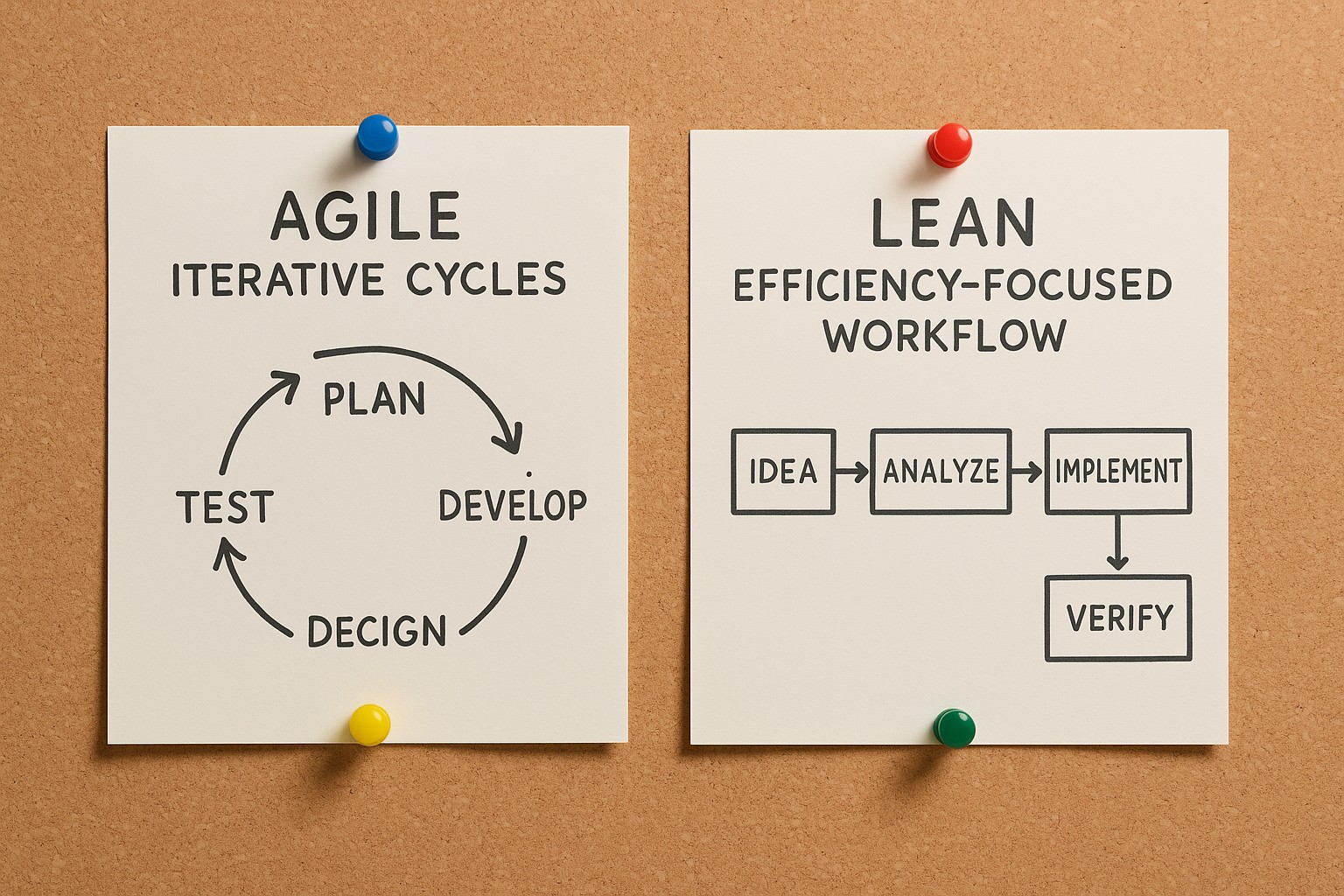
In the broad landscape of project management and product development, Agile and Lean emerged from distinct contexts but converge around the goal of delivering value faster with less waste. Agile traces its roots to software development in the late 1990s and the Agile Manifesto of 2001, which prioritized individuals and interactions, working software, customer collaboration, and responding to change. Lean has its lineage in manufacturing, specifically the Toyota Production System, and later spread to knowledge work through Lean Startup and lean development practices. Though different in origin, both philosophies emphasize learning, feedback, and reducing non-value-added work. In practice, teams often blend elements to fit their domain, creating a hybrid approach that borrows the adaptiveness of Agile and the efficiency mindset of Lean.
At a high level, Agile centers on adaptability—building small, cross-functional teams that iteratively deliver value, frequently reassessing priorities with stakeholders, and embracing change even late in the process. Lean emphasizes flow and waste elimination—aligning processes so value moves smoothly from idea to customer with as few delays, handoffs, or rework as possible. These orientations produce similar outcomes: faster feedback, higher quality, and better alignment between what a team builds and what customers actually need. The language may differ (iterations, sprints, value streams, continuous improvement), but the underlying intention is shared: maximize value while minimizing waste.
For modern organizations, the practical decision often isn’t whether to be Agile or Lean, but how to combine them in ways that fit organizational culture, product type, and market dynamics. This blending can look like using a Lean mindset to map value streams and remove bottlenecks, while adopting Agile cadences to enable quick learning and customer feedback. The resulting workflows seek to protect teams from overload, provide clear signals about priorities, and ensure that every activity contributes to delivery of valuable outcomes. In this way, Agile and Lean function as complementary lenses rather than mutually exclusive camps.
- Key terms: agile, lean, kanban, scrum, xp, kaizen, value stream mapping
- Primary sources: Agile Manifesto, Toyota Production System, Lean Startup
- Common outcomes: faster feedback cycles, reduced cycle times, improved quality
Key Principles and Practices
Agile principles revolve around responsiveness to change, incremental delivery, and strong collaboration. Lean principles focus on eliminating muda (waste), continuous improvement (kaizen), and optimizing the whole value stream. Both advocate transparency, frequent inspection, and adaptation. In practice, teams often establish short feedback loops, visible work-in-progress, and empowered decision-making to enable rapid learning and course correction. The difference lies more in emphasis than in method: Agile foregrounds customer value and adaptability; Lean foregrounds process excellence and waste reduction. When combined, teams can maintain flexible priorities while continuously improving the efficiency of their workflows.
Two sets of practices commonly associated with these philosophies include explicit cadences and board-based visualization. Cadences ensure predictable rhythm for planning, review, and retrospective activities, while visual boards make work visible and limit work-in-progress. A mature approach uses both: to prioritize work based on customer value and to remove impediments that slow delivery. In addition, metrics matter, but they should reflect learning and flow rather than purely output. Leading teams measure cycle time, lead time, and throughput, alongside customer satisfaction and defect rates to understand both speed and quality. Aligning metrics with intent helps prevent local optimization that can undermine the broader value stream.
Within this section, you will encounter three common configurations that embody Agile and Lean ideas in practice. Each configuration has its own signals, ceremonies, and governance, but all share a focus on delivering valuable outcomes with disciplined adaptability: the Lean-Agile hybrid, the Scrum with Kanban (Scrumban) approach, and the Lean-centric value-stream optimization model. The selection among them depends on product type, market stability, team maturity, and organizational culture. No single prescription fits all situations; the right approach emerges from deliberate experimentation, measurement, and learning.
- Agile with cross-functional, self-organizing teams and iterative planning cycles
- Lean-driven flow optimization: value-stream mapping, WIP limits, continuous improvement
- Cadence-driven ceremonies: planning, review, retrospective, stand-ups; visualization with boards
Practical Implications for Workflows
In day-to-day operations, Agile and Lean thinking translates into concrete workflows that teams can adopt with minimal disruption. Product discovery, backlog management, and architecture decisions are guided by rapid feedback from customers and from real usage. Teams use backlog grooming to align work with strategic goals, while sprint planning and daily stand-ups synchronize efforts. Lean influence appears as a focus on end-to-end flow: reducing bottlenecks, cutting non-value-added steps, and ensuring that handoffs between roles do not introduce waste. This results in a more predictable cadence and a clearer view of where value is created in the process.
To implement these ideas, many organizations rely on boards and dashboards that visualize work, track bottlenecks, and support continuous improvement cycles. Kanban walls reveal work in progress and highlight blocked items, prompting quick interventions. Scrum introduces time-boxed sprints and defined roles (Product Owner, Scrum Master, Development Team) to coordinate delivery and ensure alignment with stakeholder expectations. Lean influence shows up in standard work, standardized testing, and automation to reduce rework and errors. The blended approach is often referred to as Scrumban or a Lean-Agile hybrid, which aims to preserve the flow benefits of Kanban while retaining the predictable cadence of Scrum.
- Pure Scrum: fixed-length sprints, backlog-driven planning, cross-functional team collaboration
- Pure Kanban: continuous flow, explicit WIP limits, pull-based work management
- Hybrid/Hybridized configurations (e.g., Scrumban): combination of sprints and Kanban mechanics with a focus on flow and adaptability
Frequently Asked Questions
What is Agile?
Agile is a family of iterative, collaborative approaches to software and product development that prioritize close customer collaboration, early and continuous delivery of valuable software, and the ability to respond to change. It emphasizes lightweight planning, frequent feedback, and cross-functional teams that can adjust priorities as new information emerges.
What is Lean?
Lean is a philosophy and set of practices aimed at minimizing waste and maximizing value by optimizing the end-to-end flow of work. Originating from manufacturing, Lean focuses on continuous improvement, eliminating non-value-added activities, and ensuring that every step in a process contributes to outcomes that matter to customers.
Are Agile and Lean the same?
Not exactly. They share goals around delivering value faster and with higher quality, but Agile centers on flexible, collaborative processes and iterative delivery, while Lean concentrates on efficiency, process optimization, and waste reduction. In practice, many teams adopt a hybrid that blends both perspectives to fit their context.
How do kanban, scrum, and agile relate?
Scrum and Kanban are two popular frameworks often described as Agile methods. Scrum provides a structured, time-boxed cadence with defined roles and ceremonies, while Kanban emphasizes continuous flow and WIP limits. Agile is the overarching philosophy that can be implemented through Scrum, Kanban, or their combination, depending on team needs and product context.
How do I choose between Agile and Lean for a project?
The choice isn’t binary. Start by mapping the value stream for the product, identify where delays and waste occur, and assess team readiness for iterative delivery. If the priority is rapid learning and frequent customer feedback, Agile practices will be beneficial. If the focus is on streamlining flow and reducing handoffs, Lean ideas will help. Many teams succeed with a hybrid that uses Lean to streamline the flow and Agile cadences to structure learning and delivery.