Now Reading: Importance of Code Documentation and Commenting
-
01
Importance of Code Documentation and Commenting

The business value of code documentation and comments
In most software initiatives, documentation acts as a contract between teams, reducing misinterpretations and guiding decision-making when schedules shift. Clear documentation sets expectations for scope, interfaces, and responsibilities, which helps executives and managers align on priorities and tradeoffs. When requirements evolve, well-documented code helps stakeholders understand the rationale behind design choices, making it easier to adjust plans without triggering a cascade of rework.
When code is paired with clear comments and external docs, stakeholders—from developers to product managers and support teams—maintain alignment, minimize rework, and better plan dependencies. Documentation also supports risk management by capturing decisions, known limitations, and recovery procedures. In regulated environments, it becomes a backbone for audits and compliance, reducing the time teams spend justifying outcomes after the fact. A culture that treats documentation as a first-class deliverable tends to ship more predictable software and can sustain momentum during staffing changes.
- Improves maintainability and reduces total cost of ownership over the life of a project
- Accelerates onboarding of new developers and contractors
- Facilitates knowledge transfer during team transitions and reorganizations
- Supports compliance, governance, and audit readiness across releases
- Enhances planning accuracy by clarifying interfaces, dependencies, and constraints
The role of comments in code quality and maintainability
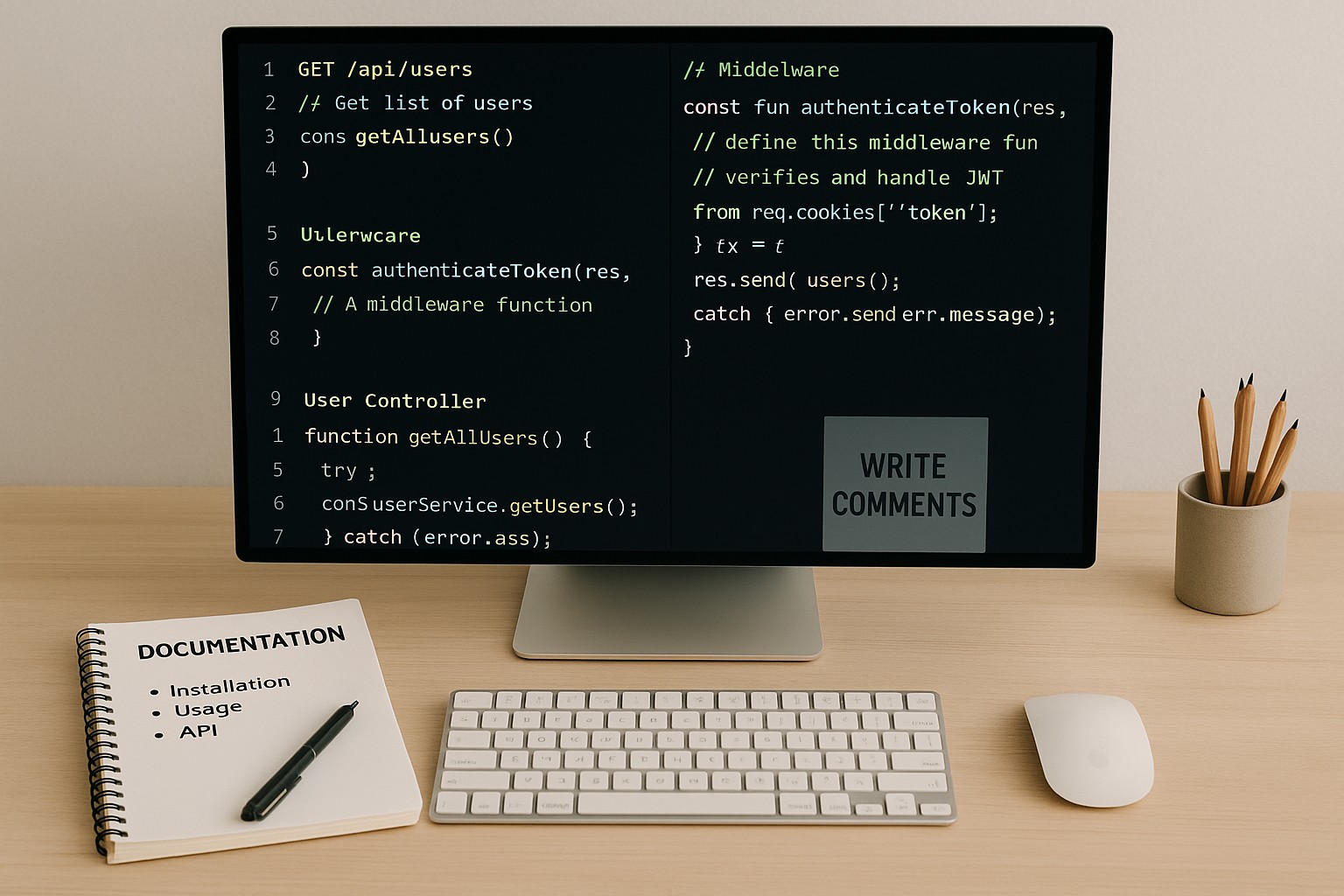
Comments are not a substitute for clean code or thorough external documentation, but they play a crucial role in explaining intent, edge cases, and decisions that are not obvious from the code itself. Thoughtful comments reduce the cognitive load on future readers, enabling them to understand why a particular approach was chosen and what assumptions underlie the implementation. Without this guidance, future changes become speculative guesswork, increasing the risk of introducing bugs or regressions.
Well-placed comments describe intent, edge cases, and future work; ensure they avoid duplicating what the code expresses. They should focus on context, rationale, and constraints, rather than restating obvious details. Over time, neglected comments create drift between the code and its commentary, undermining trust in the documentation. Teams that establish a disciplined approach to commenting—clear criteria, ownership, and periodic reviews—tave a stronger foundation for sustainable quality and faster debugging when issues arise.
- Explain rationale for complex algorithms or unusual control flows
- Note assumptions, constraints, and known side effects
- Clarify why a given approach was selected over alternatives
- Leave reminders about TODOs, debt, and known gaps in behavior
Best practices for code documentation
Effective documentation follows a consistent pattern that teams can rely on. Start with concise descriptions of modules, functions, and interfaces, and then provide deeper context where necessary. Maintain a clear separation between what the code does and why it does it that way, so readers can quickly grasp the purpose and later reflect on possible improvements. The practice of keeping docs tightly aligned with code changes—via review cycles, pull requests, and lightweight checks—helps ensure accuracy over time and reduces the friction of keeping records up to date.
Do not over-document; instead, document the intended behavior, contract, and edge cases. In particular, public APIs and module boundaries merit extra attention because they determine how other teams interact with the codebase. When documenting, use meaningful, unambiguous language and avoid duplicating information that is already obvious from the code. A small amount of well-placed context in the right place—often near the relevant function signature or interface—can save hours of puzzle-solving for a developer who is new to the area. Documentation should be maintained alongside tests to support verification and future refactoring, encouraging a culture where documentation evolves with the product.
- Use meaningful, unambiguous language that remains current over time
- Comment the why and the edge cases, not the what the code already shows
- Keep comments up to date when making changes or refactors
- Document public APIs, contracts, and module boundaries clearly
- Include small, concrete examples where helpful to illustrate usage
Documentation formats, governance, and workflows
Documentation formats range from inline comments and concise function descriptions to external guides and runbooks. The most effective approach uses a layered model: short, precise inline notes paired with higher-level docs that describe architecture, data models, and operational runbooks. This layering enables teams to access the level of detail they need without being overwhelmed by information. In practice, teams establish lightweight governance—such as naming conventions, contributor guidelines, and a simple release process for docs—to maintain consistency without slowing development. When governance is too heavy, documentation tends to lag; when it is too light, inconsistency grows and onboarding becomes unpredictable.
Organizations should align on a minimal set of templates and checklists that guide contributors through the essential sections of each document. Templates reduce cognitive load and help maintainers avoid missing critical details. Documentation should be treated as a living artifact, refreshed during code reviews, releases, and major architectural decisions. By tying documentation milestones to project milestones, teams create a predictable rhythm that supports both growth and reliability, ensuring that the documentation trail remains a trustworthy companion to the evolving product.
Onboarding, scaling documentation across teams
To scale documentation across teams, invest in lightweight templates, automation, and ownership models. Templates standardize the structure of important documents, making it easier for new teams to contribute quickly and for readers to find information consistently. Automation can help generate API references from code annotations, update diagrams when architectures change, and keep runbooks in sync with deployed environments. Clear ownership—assigning responsible individuals or teams for different areas of the documentation—ensures accountability and consistent quality as the organization grows. A pragmatic approach reduces friction in onboarding and sustains consistency across modules, even as team composition changes.
A practical way to embed documentation discipline is to treat it as part of the development process, not a bolt-on activity. For example, when writing a new function, include a short inline comment describing why the approach was chosen and how to test it, followed by a minimal external note that exposes the public contract and any caveats. Over time, this habit compounds into a robust, navigable knowledge base that supports cross-team collaboration. The emphasis should be on clarity, relevance, and timeliness—so that documentation remains a reliable resource rather than a stale artifact. You can also reference concrete examples in code, such as a small snippet like function example() { /* explain purpose here */ } to illustrate the pattern of documenting intent alongside implementation.
What is code documentation?
Code documentation is the collection of written materials that explain how a software system is designed, built, and operated. It includes inline comments, function and API descriptions, architectural overviews, data model diagrams, and runbooks that guide operational procedures. The purpose is to help developers, operators, and other stakeholders understand the system quickly, reason about changes, and maintain or extend the code with confidence.
Why are comments essential?
Comments provide essential context that raw code alone cannot convey, such as rationale for design decisions, edge-case considerations, and known limitations. They help new contributors understand intent, reduce the risk of accidental regressions, and accelerate debugging by clarifying the reasoning behind complex sections of code. Well-maintained comments reduce reliance on institutional memory and improve overall collaboration across teams.
How should documentation be maintained?
Documentation should be maintained with the same rigor as the codebase. Establish lightweight review processes, integrate documentation updates into code reviews, and align changes with tests and release notes. Use templates and automated checks where possible to keep consistency, and designate owners for different documentation domains to ensure accountability. Regular audits, such as quarterly reviews or after major refactors, help catch drift early and keep the documentation trustworthy.
How can teams measure the quality of documentation?
Teams can measure documentation quality through qualitative feedback from developers and operators, as well as quantitative indicators such as documentation coverage, the time to onboard new contributors, and the frequency of documentation-related issues. Regular surveys, paired-programming sessions, and onboarding drills can reveal gaps, while linking documentation milestones to project timelines helps demonstrate value and guide continuous improvement.
What are common pitfalls to avoid?
Common pitfalls include duplicating information that already exists in the code, letting comments become outdated, neglecting public API documentation, and creating overly long or ambiguous runbooks. To mitigate these risks, favor concise, precise language; update comments in tandem with code changes; and maintain a clear governance model that supports consistency without slowing progress.